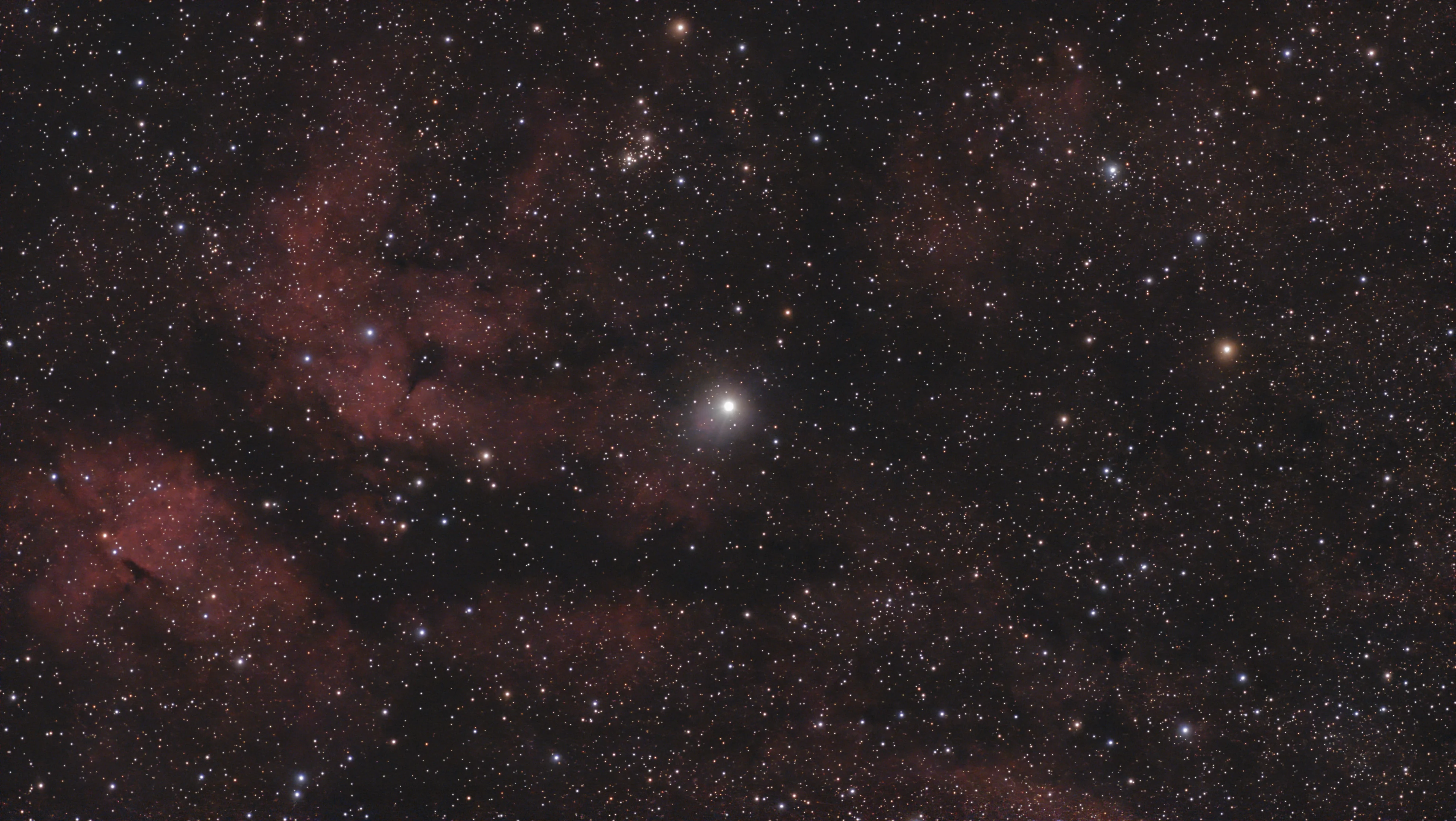
Back on IC 1318 five days after the first pass, this time with a bit more integration and a frame chosen deliberately to bring out the wings either side of Sadr — the feature that gives the nebula its popular name, the Butterfly Nebula.
Sadr itself, also catalogued as Gamma Cygni, is the yellow-white supergiant sitting at the centre of the Northern Cross asterism, marking the swan’s chest — which is literally what the name means, from the Arabic for “chest.” It’s a genuine monster of a star: around 150 times the Sun’s radius and pumping out roughly 33,000 times the Sun’s luminosity, despite being only about 12 million years old. As covered in the last post, none of that light is what’s illuminating the nebula around it — Sadr just happens to sit in the foreground, roughly 1,800 light-years away, while IC 1318 itself is nearly three times farther out.
The “butterfly” shape isn’t just a loose resemblance, either. IC 1318 is really two neighbouring clumps of glowing gas, usually labelled B and C, and what visually separates them into distinct wings is a dark, dust-choked lane called LDN 889 running between them — a foreground cloud with no relation to the nebula, simply blocking the view of what’s behind it. That dark seam is what turns one continuous field of hydrogen-alpha emission into something that reads as two wings either side of a body.
With the extra five minutes of integration over last time, more of the fainter filamentary structure in the wings starts to separate out from the background star field. Still not the deep, hours-long stack this target really deserves, but a step further into it. Full details, and a link through to the 3D distance view, are on the photo page.