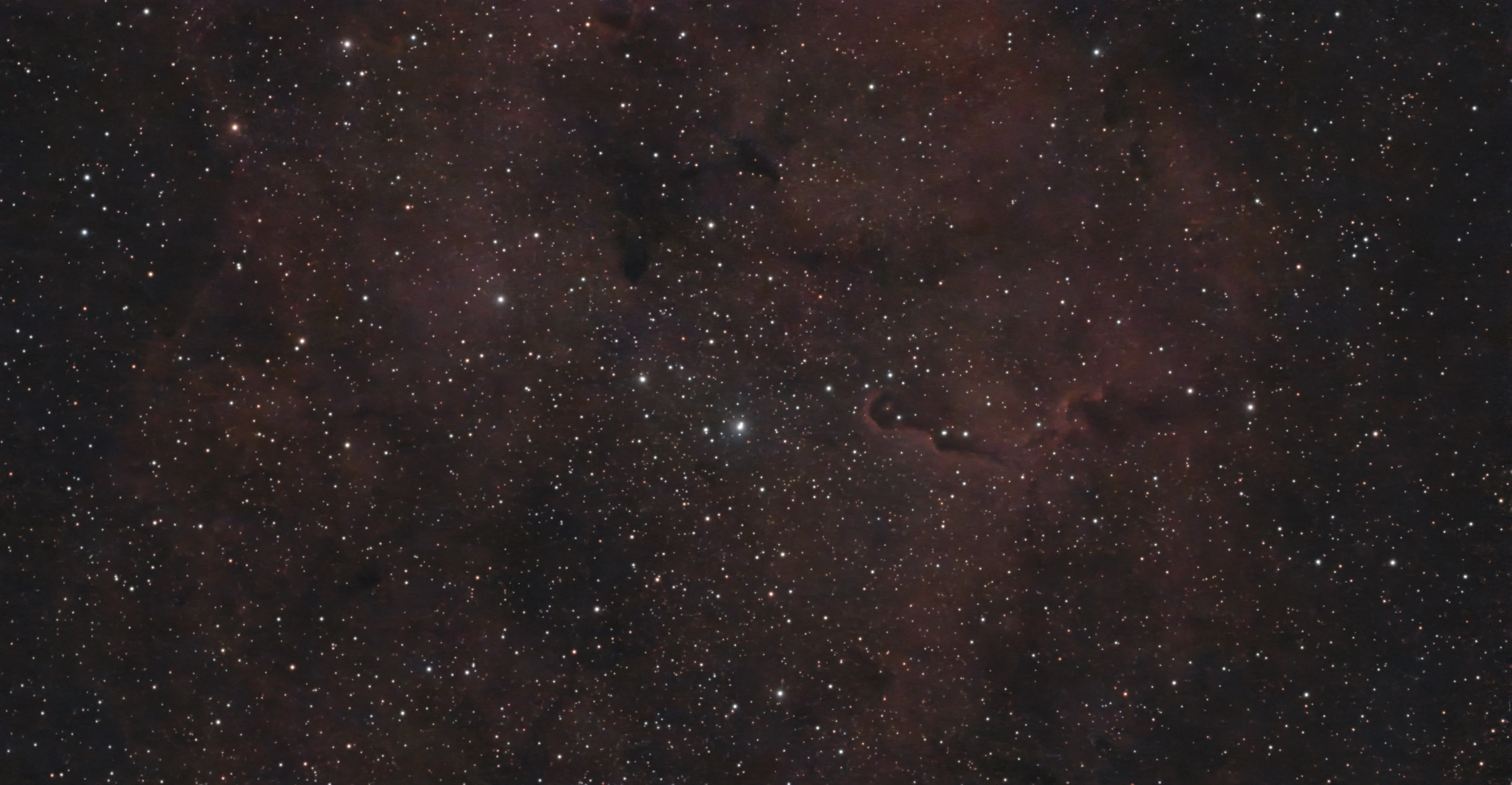
A new target tonight, and a proper sit-down with it — 3 hours 12 minutes of integration, the longest run I’ve given a nebula since the Bubble. The Elephant’s Trunk Nebula, catalogued as IC 1396A, is a winding rope of cold, dusty gas hanging inside the much larger IC 1396 emission complex in Cepheus, around 2,400 light-years away. The parent nebula sprawls across more than three degrees of sky — six full Moon widths — which makes the trunk itself easy to underestimate: that sinuous dark curl is over 20 light-years long.
What gives the trunk its shape is a single, brutal light source. At the centre of IC 1396 sits HD 206267, a ferociously hot O-type star (actually a multiple system) whose ultraviolet radiation floods the entire complex. The trunk is a globule dense enough to survive that onslaught — for now. Its bright, glowing rim is the ionisation front, the exact surface where the star’s radiation is boiling gas off the cloud and driving it away, a process called photoevaporation. The trunk essentially points back at its tormentor like a streamer blown in the wind.
The same radiation that’s destroying the globule is also midwifing the next generation of stars. As the ionisation front compresses the gas ahead of it, pockets inside the trunk collapse under their own gravity. Infrared observations — Spitzer in particular — have found a clutch of protostars buried in the trunk’s head, some less than 100,000 years old, which is barely a heartbeat on stellar timescales. There’s even a small cavity near the tip, carved out by a pair of slightly older young stars, that gives the “head” of the elephant its hollowed-out look. In a few million years the trunk will be gone entirely, evaporated away, leaving the new stars it made behind.
From an Edinburgh sky the trunk is all about hydrogen-alpha, and this is where the integration time earns its keep — the dark spine of the globule only reads properly once the surrounding emission is smooth and deep enough to silhouette it. Three-plus hours got there. As a bonus, the field sits near Mu Cephei, Herschel’s Garnet Star, one of the reddest naked-eye stars in the sky and a genuine red supergiant monster. Full details, and a link through to the 3D distance view, are on the photo page.