What is Bortle?
Nine classes of darkness · And what each one costs you in time
The Bortle scale is a nine-point measure of how dark your night sky actually is. Class 1 is a genuinely pristine sky — the kind that still exists in a few remote corners of the world, where the Milky Way casts a shadow. Class 9 is an inner-city sky where a handful of the brightest stars are all that survive the glow. Lower is darker; higher is worse.
It was published by John E. Bortle in Sky & Telescope in 2001, and it caught on because it gave amateur astronomers a shared vocabulary for something everyone could see but nobody could quantify. It’s an observational scale rather than an instrument reading — you place your sky by what you can and can’t see from it — which makes it approximate by design, but useful precisely because it describes the sky you’re standing under rather than a number on a meter.
For anyone imaging with a smart telescope, it’s the single most important number about your location, because it sets the price of every photo you take. Not in money — in hours.
The nine classes
Most people who think they have a dark garden have a Class 5 or 6. Genuine Class 1 and 2 skies are rare enough that people travel to them deliberately — and the difference between a Class 4 sky and a Class 7 one is far larger in practice than three steps on a nine-point scale makes it sound.
Why it costs you time
The physics is unglamorous. Every image you take contains signal — photons from the thing you’re pointing at — and noise, which is everything else: the sky’s own glow, plus the sensor’s own contribution. What determines whether a faint nebula appears in your final image isn’t how much signal you gathered but the ratio between the two, the signal-to-noise ratio.
Skyglow doesn’t hide your target by covering it up. It swamps it. The light pollution lands on the same pixels as the nebula, and because the arrival of photons is random, that background brings its own statistical noise along with it — noise that grows with the square root of how much of it you’ve collected. Stacking beats it down, because the signal accumulates in step with exposure time while the noise only accumulates with its square root. That’s why integration time works at all.
But it also means the returns are punishing. Doubling your signal-to-noise ratio takes four times the exposure. A sky that is several times brighter doesn’t cost you several times as long — it costs you a good deal more than that, and the faintest targets can move out of reach entirely no matter how long you leave the telescope running.
| Dark Sky (Bortle 1–3) |
Suburban (Bortle 4–5) |
Bright Suburban / City (Bortle 6–7) |
City / Inner City (Bortle 8–9) |
|
|---|---|---|---|---|
| Noise level | Very low | Low – moderate | High | Very high |
| Integration time for the same result | 0.5× – 1× | ~1.5× – 3× | ~3× – 8× | ~8× – 20×+ |
| What that means in practice | Faster results, more detail in less time. Faint targets are realistic. | Slightly longer sessions needed, but still very productive. | Expect long sessions. Fewer faint details in the same time. | Very long sessions for faint targets. Best on bright objects. |
Multipliers are relative to a Bortle 3 baseline, for a deep-sky target of the same brightness.
What this looks like from Edinburgh
Every image in the gallery was taken from Edinburgh, which sits around Bortle 7 to 8 depending on where in the city you’re standing — city skyglow shading into bright city sky, straddling the right-hand two columns above. There is no version of this hobby here where a faint target is a quick job, and the capture times on the photo pages show it plainly.
The pattern in that data is the useful part. Emission nebulae — the Crescent, the Bubble, the Elephant’s Trunk — came in at roughly one to three hours each. Broadband galaxies took far longer: four hours for M33 and M81, seven for Andromeda and the Pinwheel, ten for the Whirlpool. Same telescope, same sky, same city. The difference is entirely what can be filtered.
That’s the loophole. Emission nebulae glow at specific wavelengths — hydrogen-alpha and oxygen-III — and a dual-band filter passes those while rejecting most of the sky’s broadband glow, so a heavily light-polluted sky behaves like a far darker one for that class of target. Galaxies and star clusters shine across the whole visible spectrum, and no filter can separate their light from a streetlight’s. For those, the only currency is time.
Working with the sky you have
The short version
Higher Bortle means more skyglow, which means more noise, which means more hours for the same picture. Dropping from Bortle 7 to Bortle 3 can cut the integration time you need by three to eight times or more — a better sky beats better gear, and it beats more patience.
A few things follow from that, in rough order of how much they help:
- Travel if you can. An hour’s drive to a Bortle 4 site does more for your images than any upgrade you can buy. Nothing else on this list comes close.
- Use a dual-band or narrowband filter for emission nebulae. From a city this is the difference between a target being possible and impossible, not merely between fast and slow.
- Pick targets that suit your sky. Bright nebulae, large galaxies, star clusters, planets and the Moon all hold up well under heavy light pollution. Faint dwarf galaxies and reflection nebulae will punish a bright sky no matter how long you run.
- Stack across nights. Integration doesn’t have to be continuous. Combining sessions is how the long exposures here were built, an hour at a time, whenever the weather allowed.
- Shoot high. Skyglow is worst near the horizon, where you’re looking through the most atmosphere and the most city. A target overhead is in a measurably darker sky than the same target low down.
- Block direct light. A neighbour’s security light or an unshielded streetlamp in the frame does more damage than the general skyglow, and unlike the skyglow you can usually park something between it and the telescope.
None of this makes a city sky into a dark one. It makes a city sky workable, which is a different and more achievable goal — and the gallery is what that looks like in practice.
The whole scale on one card
Everything above, on a single sheet — handy for saving or sharing. Click for the full-size version.
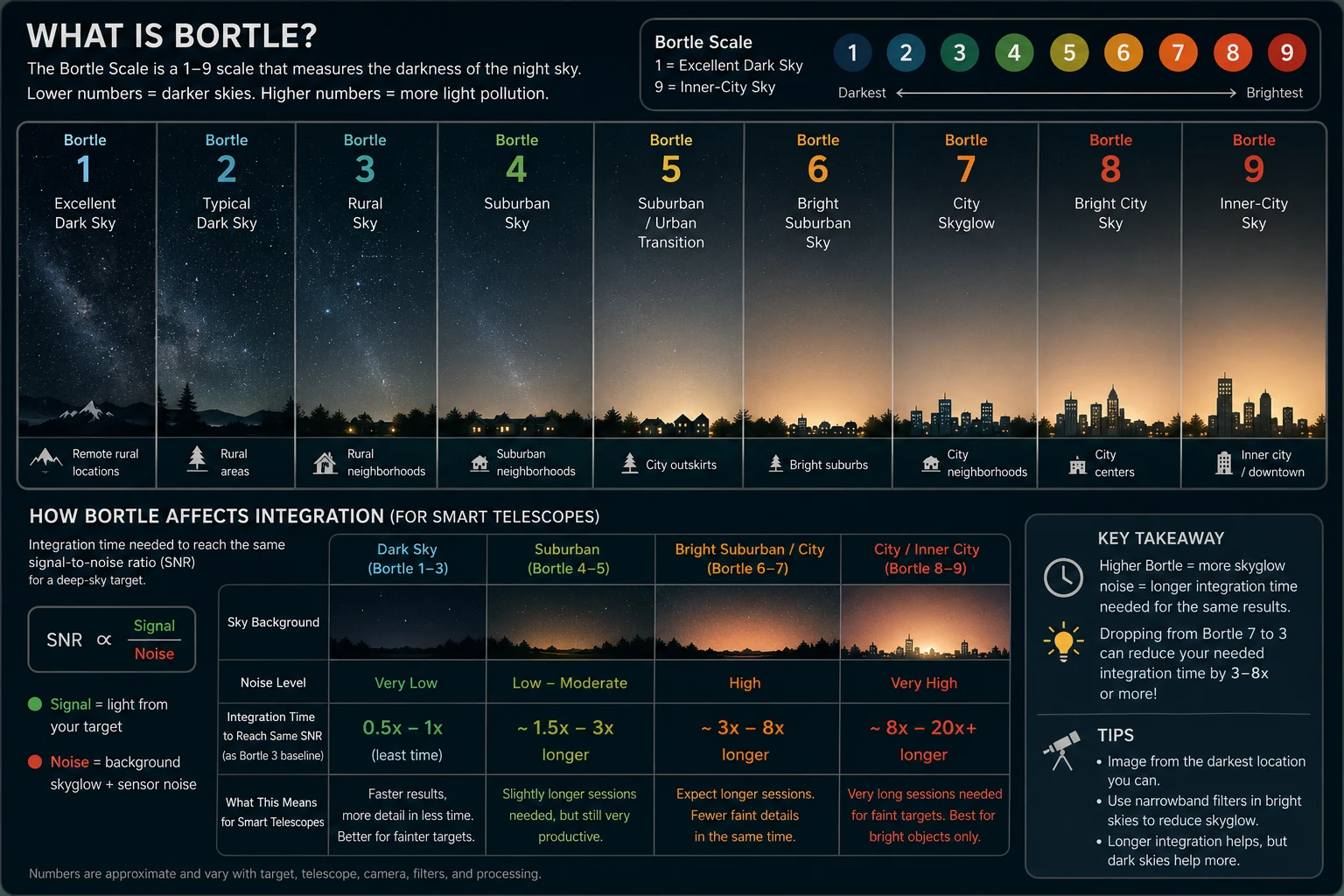
The multipliers above are approximations. Real integration times vary with target brightness, telescope aperture and focal ratio, sensor performance, filter choice, moon phase, transparency and processing. Treat them as the right order of magnitude rather than a formula — the direction and rough scale are reliable, the exact numbers are not.