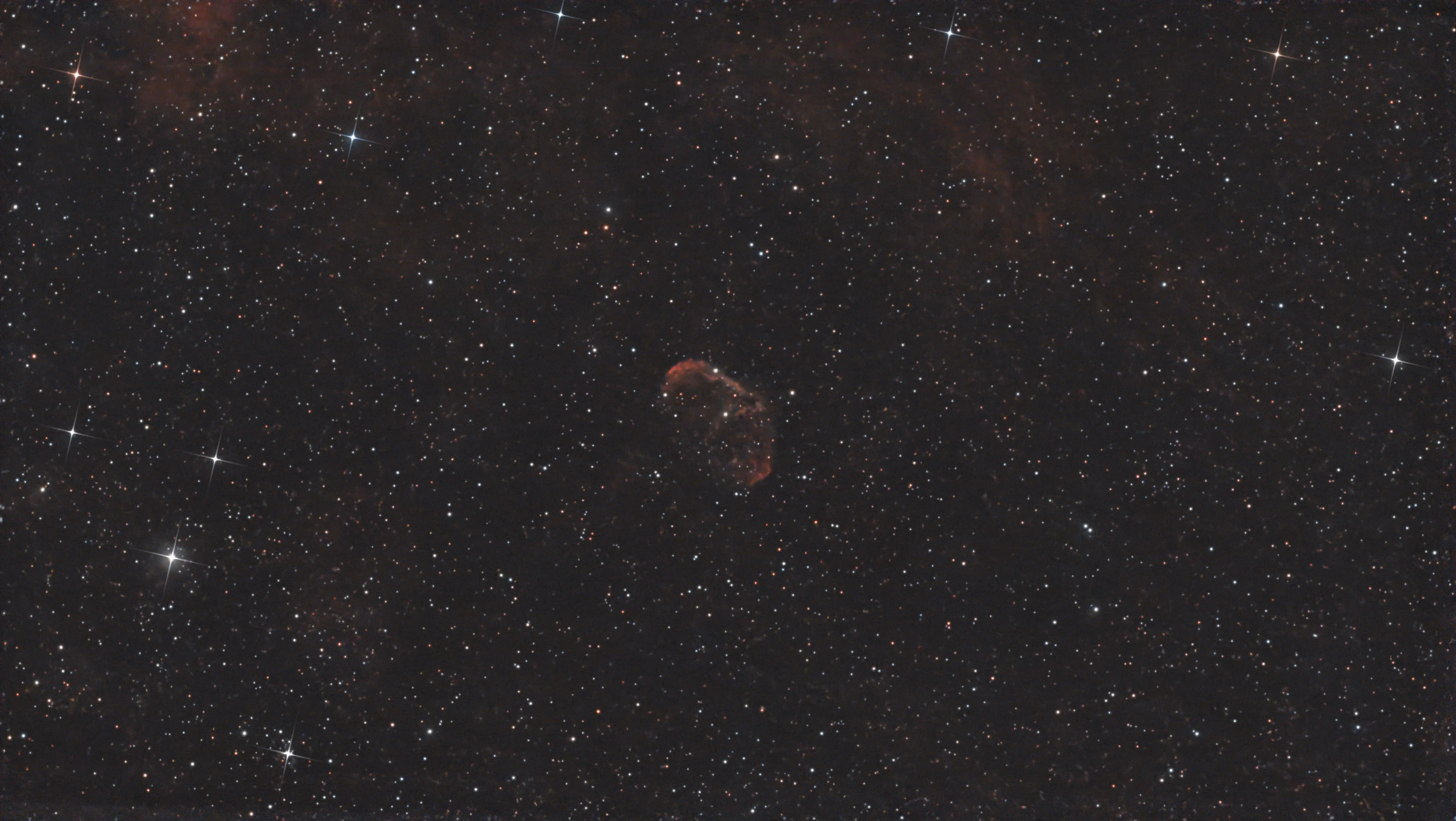
Back to an old target tonight with a fresh set of subs — an updated take on the Crescent Nebula, NGC 6888, with 1 hour 10 minutes of integration. This wolf-rayet wind nebula in Cygnus is one of the more dramatic shapes in the northern sky: a shell of gas blown off and lit up by WR 136, a massive, rapidly evolving star sitting at its centre, around 5,000 light-years away.
The crescent shape itself is a story of two stellar winds colliding. Earlier in its life WR 136 was a red giant, shedding a slow, dense wind of material into the space around it. Now, having stripped away its outer layers, the star is exposed as a wolf-rayet — a hot, compact remnant driving a much faster, thinner wind. That fast wind is ploughing into the older, slower shell, compressing and heating it into the glowing arc we see. It’s a shockwave frozen in a single frame, though on stellar timescales it’s still very much in motion.
WR 136 won’t stay this way for long. Wolf-rayet stars are living fast and dying young, and this one is a strong candidate to go supernova within the next few hundred thousand years — a blink of an eye against the star’s overall lifespan. When it does, the explosion will slam into the very nebula it’s currently sculpting, likely reshaping the whole structure into something closer to a supernova remnant.
Getting the Crescent to hold together against Edinburgh’s skyglow took every minute of that hour-plus, but the extra depth compared to my first pass shows noticeably more of the faint outer wisps trailing off the main arc. Full details, and a link through to the 3D distance view, are on the photo page.