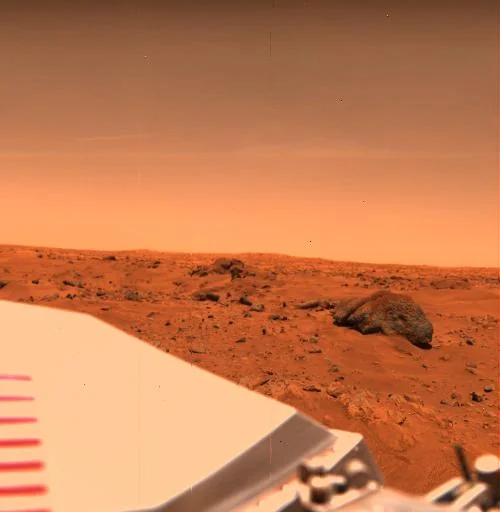
Nothing on this site was taken from another planet’s surface, except this. A grey-brown boulder sitting in rust-coloured dirt under a hazy salmon sky, with the corner of a spacecraft intruding into the bottom-left of the frame. It looks like a snapshot someone took on a bad camera in a quarry. It is the surface of Mars, photographed fifty years ago last week, and the rock has a name: Big Joe.
The picture comes from Viking 1, which set down on Chryse Planitia on 20 July 1976 — a date that landed, neatly, on the seventh anniversary of Apollo 11, though it was arrived at for far less romantic reasons. The original 4 July target had to be abandoned. Orbiter images of the intended landing site came back looking rougher than anyone had hoped, and rather than gamble the whole mission on a bad patch of ground, the team spent two weeks scouting for somewhere smoother. Landing on Mars in 1976 meant committing to a spot you could only see from orbit, then finding out what you’d actually chosen after you were already sitting in it.
Big Joe is the largest rock in the lander’s view: roughly two metres across, about eight metres from the spacecraft. What makes it more than a big rock is the way it’s dressed. The top carries a pale reddish coating of the same fine dust that covers everything, while the flanks are noticeably darker — a thin veneer of windblown material sitting on something much darker underneath, most likely volcanic in origin. It’s the sort of detail you get from being on the ground and nowhere else, and it told geologists that the red Mars we see from orbit is largely a coat of paint over a grey-black planet.
The plain it sits on is worth the name. Chryse Planitia — the Golden Plain — is a low basin in the northern hemisphere where several enormous outflow channels empty out, the kind of channels carved by catastrophic floods of water in Mars’ distant past. That history is written all over the scene: a jumble of rocks of wildly different sizes strewn across a surface that should, geologically speaking, be smooth. Big Joe was probably flung here as ejecta from an impact, or carried and dumped by moving water. Twenty-one years later, Mars Pathfinder came down in Ares Vallis at the edge of the same region, and found much the same thing — a rock-littered floodplain, ancient and dry.
The image itself was made in a way that would horrify a modern imager. Viking’s cameras weren’t sensors in the sense I’d recognise; they were facsimile scanners, building a picture one vertical line at a time as the optics rotated, with colour assembled from separate filtered passes. If you look closely you can see the faint vertical structure in the sky where that scanning shows through. A single frame took minutes to acquire and had to be radioed back across interplanetary distance, line by line.
And down in the lower-left corner, on the lander’s deck, is the striped colour reference chart — the reason we can trust the colour at all. Viking’s first colour release famously came out with a blue sky before the calibration was properly applied, and the corrected version turned it the dusty butterscotch we now think of as Martian. That’s a problem I recognise. Every capture on this site goes through the same argument with itself: what colour is this thing actually, and how much of what I’m seeing is the instrument, the atmosphere and Edinburgh’s sodium glow. Viking solved it by bolting a known reference to the spacecraft and photographing it alongside the landscape. Fifty years on, the trick hasn’t changed much, just the scale.
Which is the part I keep coming back to. My usual work here is the opposite of this photograph — hours of integration on a target thousands of light-years away, hundreds of frames stacked into something no single exposure could show. Big Joe took one pass of a slow-scanning camera on a machine that had already done the hard part by surviving the landing. Nothing about it is deep or faint or hard-won in the way a nebula is. It’s just a rock, eight metres away, on a planet nobody had ever stood on. This site lives at chryse.co.uk, and this is the plain it’s named for.
Image: NASA/JPL, Viking 1 Lander, 1976. Public domain.