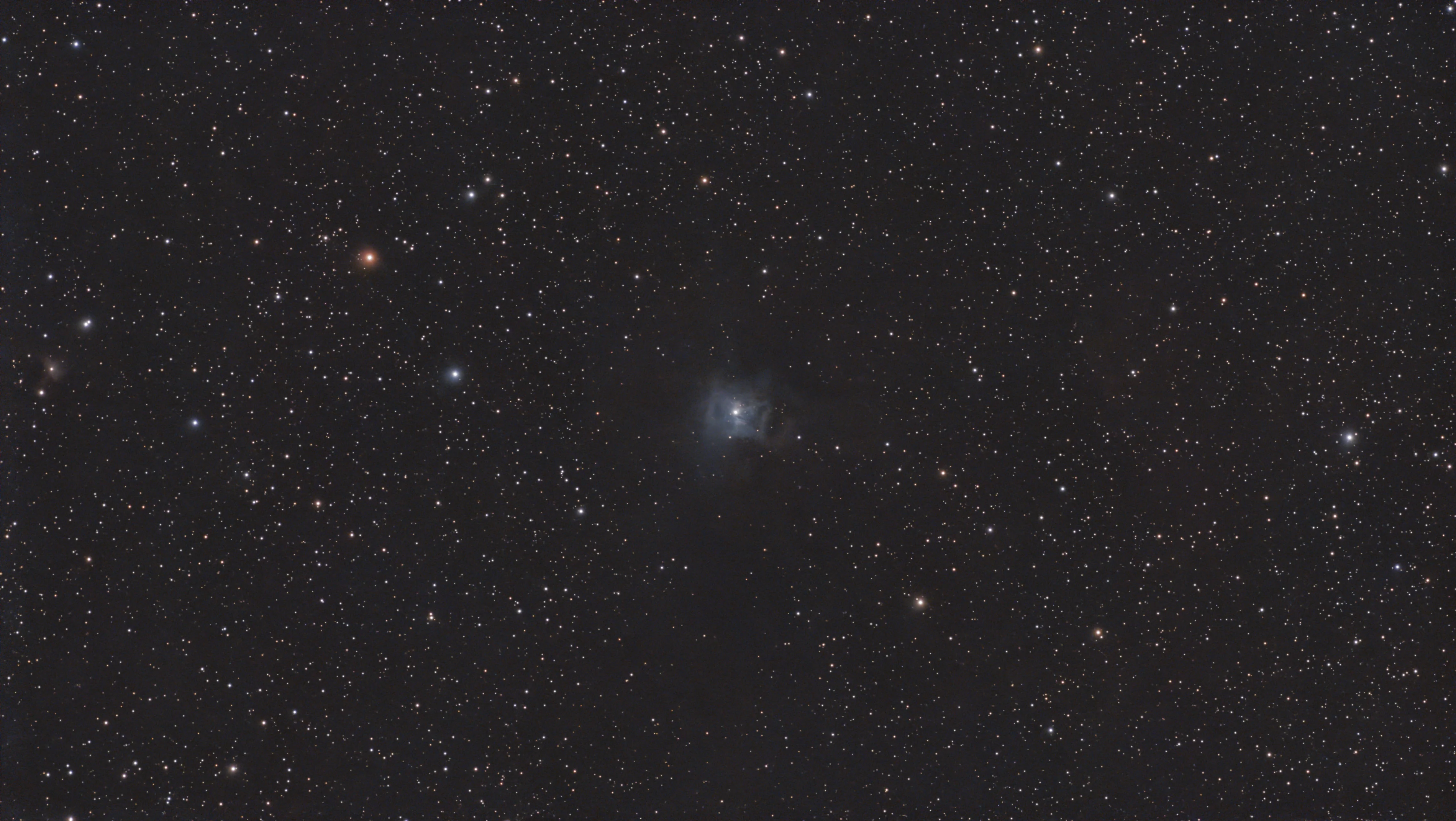
Back to the Iris for a second attempt, and this time with something like a proper run behind it — 1 hour 45 minutes of integration against the 40 minutes I gave it in June. The Iris Nebula, Caldwell 4, sits in Cepheus around 1,300 light-years away, and it earns its name honestly: at the right stretch the pale blue structure really does open out like the petals of a flower.
What makes it interesting is that almost none of that light belongs to the nebula. Emission nebulae like the Crescent or the Elephant’s Trunk glow because their gas has been ionised and is radiating on its own account. The Iris does nothing of the kind. It is a reflection nebula — a cloud of cold dust sitting close enough to a bright star to scatter its light back at us. The star is HD 200775, a hot young Herbig Be object buried in the middle of the petals, itself a close massive binary that has blown a cavity out of the cloud around it. The blue cast is the same physics that colours the daytime sky: the dust grains scatter short wavelengths more efficiently than long ones, so what reaches us is bluer than the star that supplied it. Second-hand starlight, filtered on the way out.
The dust is also doing chemistry. NGC 7023 is one of the best-studied sources of polycyclic aromatic hydrocarbons anywhere in the sky — large, ring-shaped carbon molecules whose infrared signature is unusually strong here, which is why the region turns up so often in interstellar chemistry papers. Alongside that there is extended red emission, a faint reddish photoluminescent glow where grains absorb the star’s ultraviolet output and re-radiate it at longer wavelengths. Neither effect is something a small telescope in a city is going to separate out, but it is worth knowing that the faint colour gradients across those petals are the visible edge of a genuinely complicated bit of astrophysics.
One piece of pedantry the catalogues invite: NGC 7023 technically designates the small open cluster embedded in the cloud, not the nebulosity. The bright part everyone photographs is properly LBN 487, and the whole thing sits inside a much larger dark molecular complex — which is really the other half of the picture. The petals are small, but the dust they belong to sprawls well beyond them, and in a deep enough frame you start to see it as a mottled brown haze choking off the star field rather than as anything with an edge.
That surrounding dust is where the extra hour actually went. At 40 minutes I had the bright core and not much else; at 1h 45m the dark cloud around it starts to register, and the Iris stops looking like an isolated blue smudge and starts looking like the brightest spot in something bigger. It is still a small target in a wide, star-choked Cepheus field — the Milky Way is thick through here and the frame is mostly stars — but the petals hold their shape now, and the faint outer scattering is present rather than implied. Full details, and a link through to the 3D distance view, are on the photo page.