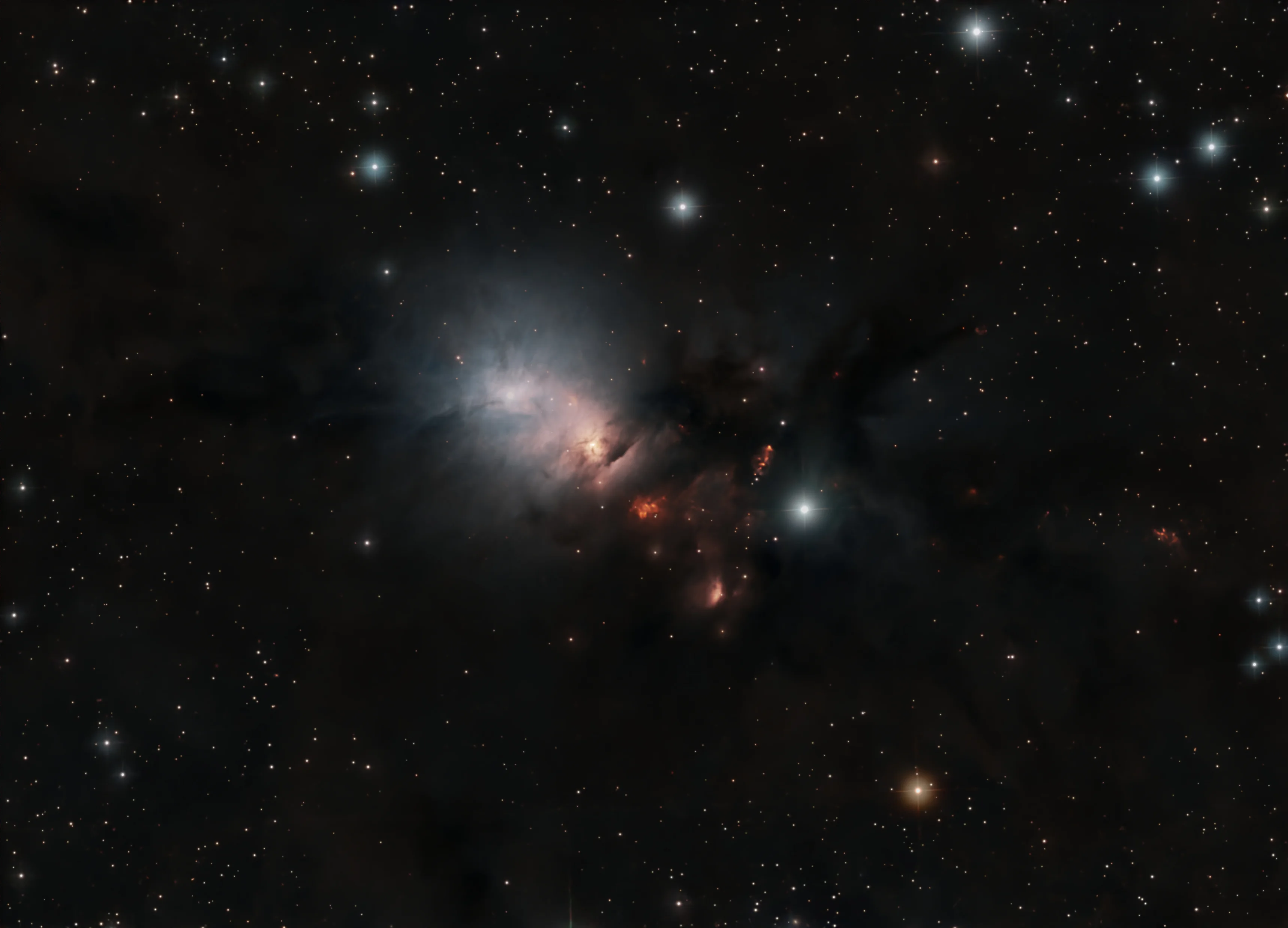
This one has been sitting on a drive since last November. Six hours on NGC 1333, captured on a dark night in Perseus season and then, for no better reason than the usual backlog, left unprocessed until now. It was worth the wait: the nickname is the Embryo Nebula, and it is one of the few objects where the popular name is doing real work rather than pattern-matching a shape.
NGC 1333 sits about 1,000 light-years away at the western end of the Perseus molecular cloud, and it is one of the nearest places in the sky where low-mass star formation is happening right now. The blue lobe filling the upper left of the frame is reflection — cold dust scattering the light of a hot young star sitting inside it, the same mechanism as the Iris Nebula, no gas glowing under its own power. That distinction matters here more than usual, because NGC 1333 has no massive stars at all. There is no O or B-type monster carving out an HII region the way there is in Orion, only a swarm of small ones, and so the nebula has to make its colour by other means.
Which is where the interesting half of the picture comes in. The ragged orange and red knots strung through the dusty southern part of the frame are not photoionised gas. They are Herbig-Haro objects — places where a jet of material, flung out at hundreds of kilometres per second by a protostar still in the act of forming, has ploughed into the surrounding cloud hard enough to shock-heat it into glowing. The best-known chain of them, HH 7 through 11, sits in this region, driven by an embedded protostar called SVS 13 that is far too buried in dust to see directly. What you can see is the damage it is doing. Every one of those knots is the visible end of an invisible object.
There are a great many of them, and that turns out to matter. NGC 1333 is packed with several hundred young stellar objects, most under a million years old, and the collective effect of all their outflows is to punch cavities through the cloud and stir turbulence back into it. The current thinking is that this is a feedback loop with teeth: the newly-formed stars are actively disrupting the material that would otherwise go on to form more of them, in a region with nothing massive enough to do the job by supernova. A nursery that partly shuts itself down.
The other reason the region gets attention is the failures. NGC 1333 contains an unusually high proportion of brown dwarfs — objects that condensed out of the same cloud but never accumulated enough mass to ignite hydrogen fusion, and so spend their lives slowly cooling. The ratio here is high enough that the region has become a standard reference for arguments about how the bottom end of the stellar mass function gets populated. Almost none of them are in this frame in any visible sense; they are infrared objects buried in dust. But they are in there, sharing the same cloud as the protostars that made it, and the whole thing is only a million years old — which is to say that essentially everything in this photograph is younger than the human species. Full details, and a link through to the 3D distance view, are on the photo page.