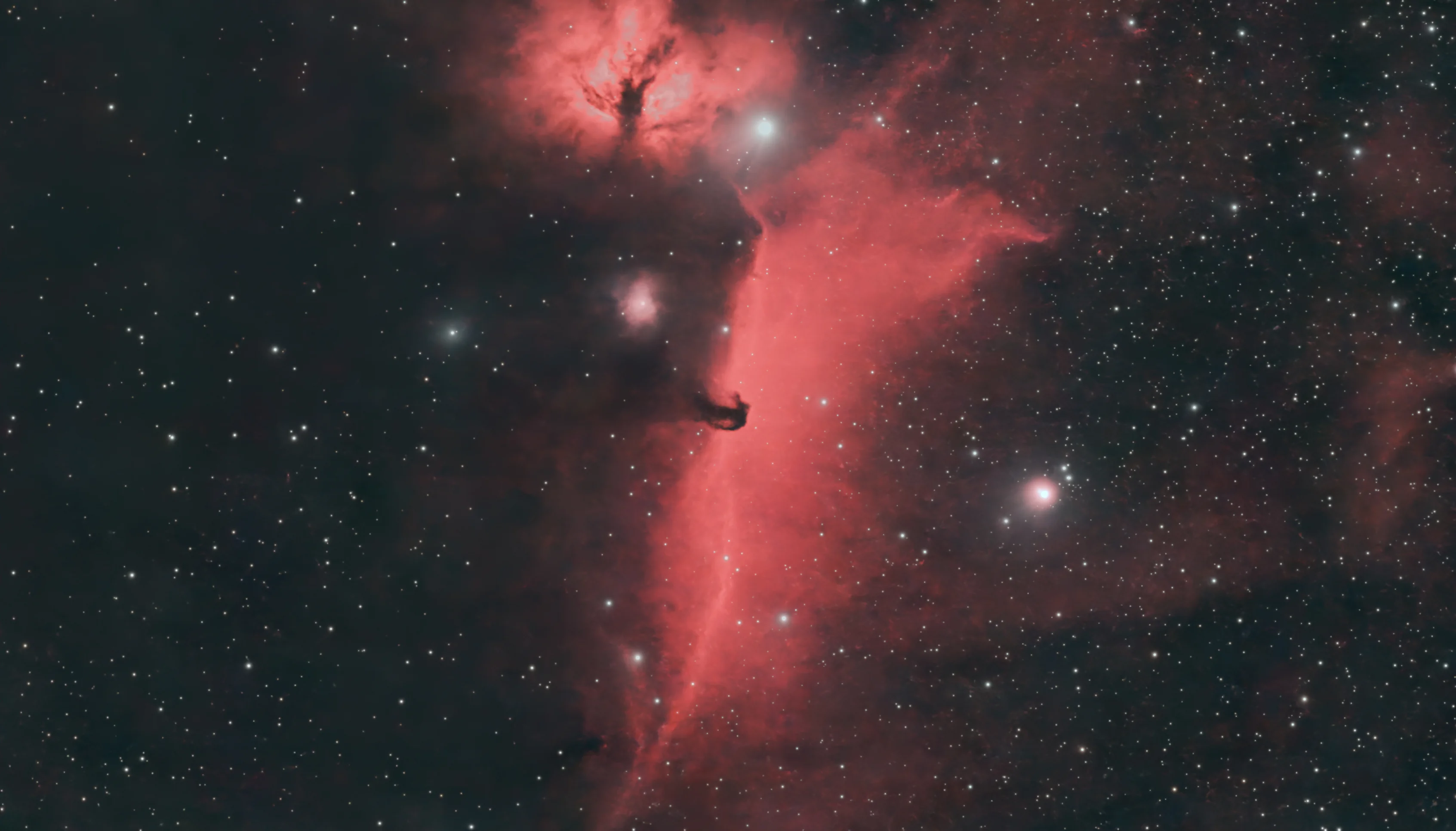
Another trip back through the archive, this time to January’s Horsehead. Same 2 hours 27 minutes of subs, new stack, and the thing that changed most is the ridge. IC 434 — the wall of red hydrogen the horse’s head bites into — is the hardest part of this field to handle, because it is bright, it is smooth, and any clumsiness in the stretch turns it into a flat pink slab with the dark nebula pasted on top. It should read as a surface with depth behind it, and this version finally does.
The Horsehead itself, Barnard 33, is a dense protrusion of cold dust and molecular gas about 1,375 light-years away, part of the vast Orion molecular cloud that fills this whole quarter of the constellation. It emits nothing. What you are looking at is an absence — a lump of opaque material blocking the glow of the ionised hydrogen behind it. The gas is being lit by Sigma Orionis, the multiple star system sitting bright and obvious towards the lower right of the frame, whose ultraviolet output is stripping electrons from the hydrogen along a front that happens to be edge-on to us. That is why the ridge is a ridge rather than a haze: we are seeing an ionisation boundary side-on, like the edge of a sheet of paper.
The head is not permanent. The same radiation lighting the background is eroding the pillar, and current estimates give it something like five million years before it is worn away entirely. We are looking at a shape with an expiry date, which is a strange thing to say about something that has been on astronomy posters since before anyone alive was born.
It has been on plates a good deal longer than that. B33 was picked out in 1888 by Williamina Fleming, working at Harvard College Observatory — a Scot from Dundee who had arrived in America, been abandoned by her husband while pregnant, taken work as a maid in the household of the observatory’s director, and ended up running its plate-classification effort and cataloguing tens of thousands of stellar spectra. She spotted the notch in IC 434 on a photographic plate. When the discovery filtered into the published catalogues, the credit attached to the observatory and its director rather than to her by name, which was the ordinary fate of the women doing that work at the time. The object’s popular name arrived later and stuck; her name did not, at least not for a long while.
Two other things share the frame and are worth knowing by name. The bright complex at the top is the Flame Nebula, NGC 2024, with the dark dust lane splitting it — that lane is foreground material, not a gap, and the whole nebula sits behind Alnitak, the blazing easternmost star of Orion’s Belt just beside it. The small round glow to the left of the Horsehead is NGC 2023, one of the larger reflection nebulae in the sky and easy to dismiss as a bright star until you look properly. Three separate mechanisms — emission, reflection, and pure obstruction — inside one frame, which is most of why this patch of Orion is photographed as relentlessly as it is. Full details, and a link through to the 3D distance view, are on the photo page.