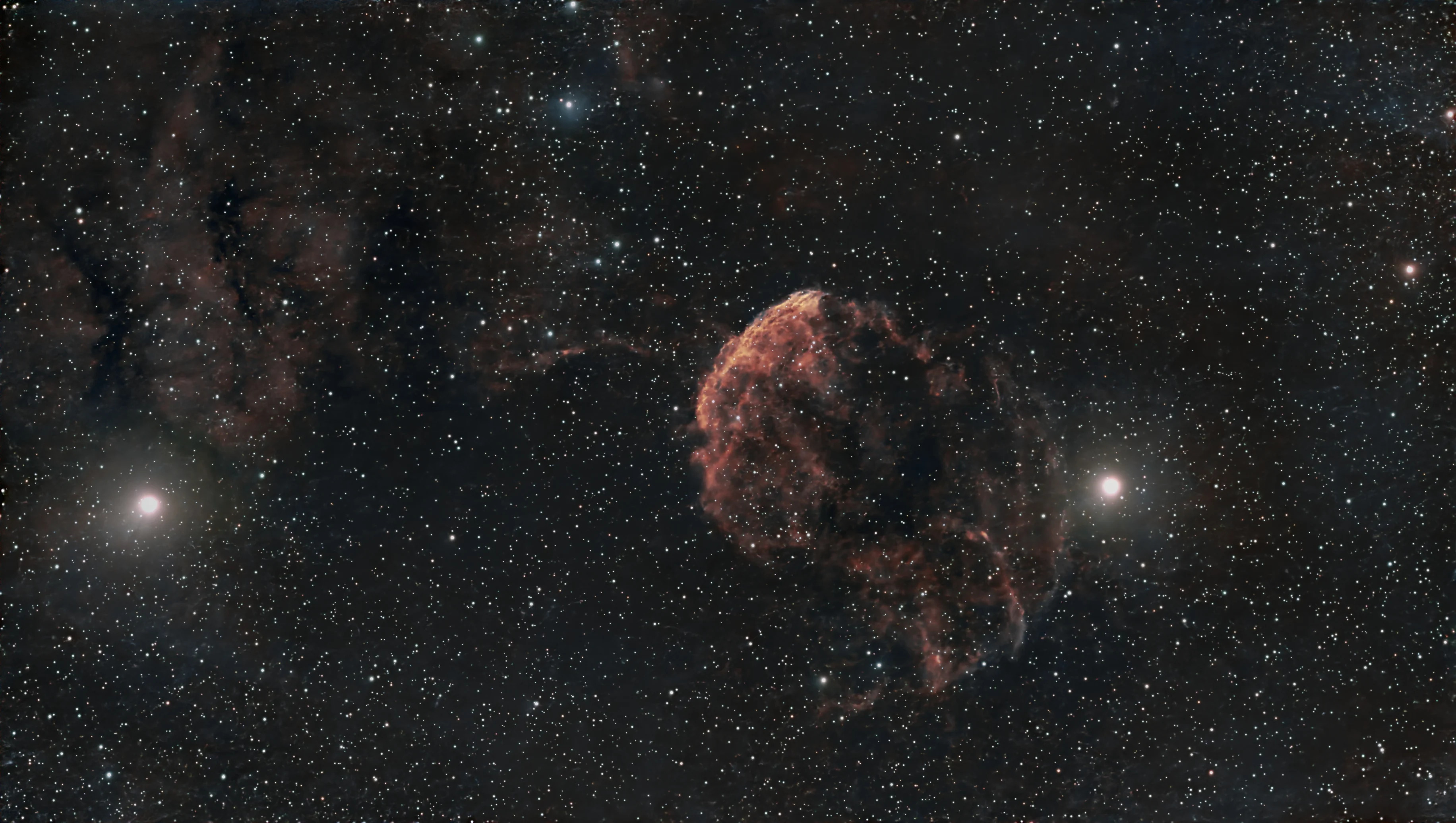
No new photons here — this is the same September 2025 data on IC 443, taken back through the stacking and stretching from scratch. All 3 hours 26 minutes and 45 seconds of it were sitting in the original capture; I just never got much out of them the first time. The reprocess is not a subtle improvement: the bright northern rim now breaks up into the ropey, crinkled filaments it should have, and the fainter southern half of the shell shows as structure rather than as noise I was hoping was structure.
IC 443 is a supernova remnant in Gemini, roughly 5,000 light-years away, and it is the wreckage of a massive star that blew itself apart somewhere between 3,000 and 30,000 years ago. The spread on that number is not laziness on anyone’s part — dating a remnant means modelling how fast the shock has slowed, and IC 443 is expanding into a genuinely messy neighbourhood, so different assumptions give wildly different answers. What it left behind sits at the southern edge of the shell: a neutron star, CXOU J061705.3+222127, trailing a small cometary pulsar wind nebula. Its apparent direction of travel is awkward. Run it backwards and it does not obviously point at the geometric centre of the remnant, which is one of several reasons IC 443 keeps turning up in papers with question marks in the title.
The lopsidedness is the most interesting thing in the frame. The northeastern rim — the bright, sharp arc across the top of the shell — is the shock front ploughing into relatively thin atomic gas, free to expand and glowing cleanly as it goes. The southern portion is a different story: there the blast wave has run into a dense molecular cloud and effectively stalled against it, and instead of a crisp edge you get the broader, softer, more chaotic emission that fills the lower half of the nebula. That collision has made IC 443 one of the best-studied shock-versus-molecular-cloud interactions anywhere in the sky, complete with the 1720 MHz OH masers that are the standard fingerprint of the process.
It also made the Jellyfish a minor landmark in a much older argument. Cosmic rays — mostly protons, hammering into the atmosphere from all directions — had been suspected of coming from supernova remnants since the 1930s, but suspicion is not evidence, and electrons accelerated at the same shocks can fake most of the signatures. IC 443 helped settle it. Because the shock is slamming into dense material, the accelerated protons have something to collide with, and those collisions produce neutral pions that decay into gamma rays with a characteristic spectral shape that electrons cannot mimic. Fermi-LAT found exactly that shape here, published in 2013, and the case for supernova remnants as proton accelerators stopped being circumstantial. The soft glow in the bottom half of my frame is, in a roundabout way, where that was demonstrated.
Two bright stars anchor the field either side of the remnant — Eta and Mu Geminorum — and there is a fair amount of faint dust and nebulosity drifting through the upper left of the frame that was nowhere to be seen in my first version of this image. It was always in the data. The lesson I keep relearning is that with a large, low-surface-brightness target under city skies, the gap between a shape and a structure is often sitting in the subs already, waiting on a better stretch rather than another clear night. Worth going back through the archive occasionally. Full details, and a link through to the 3D distance view, are on the photo page.