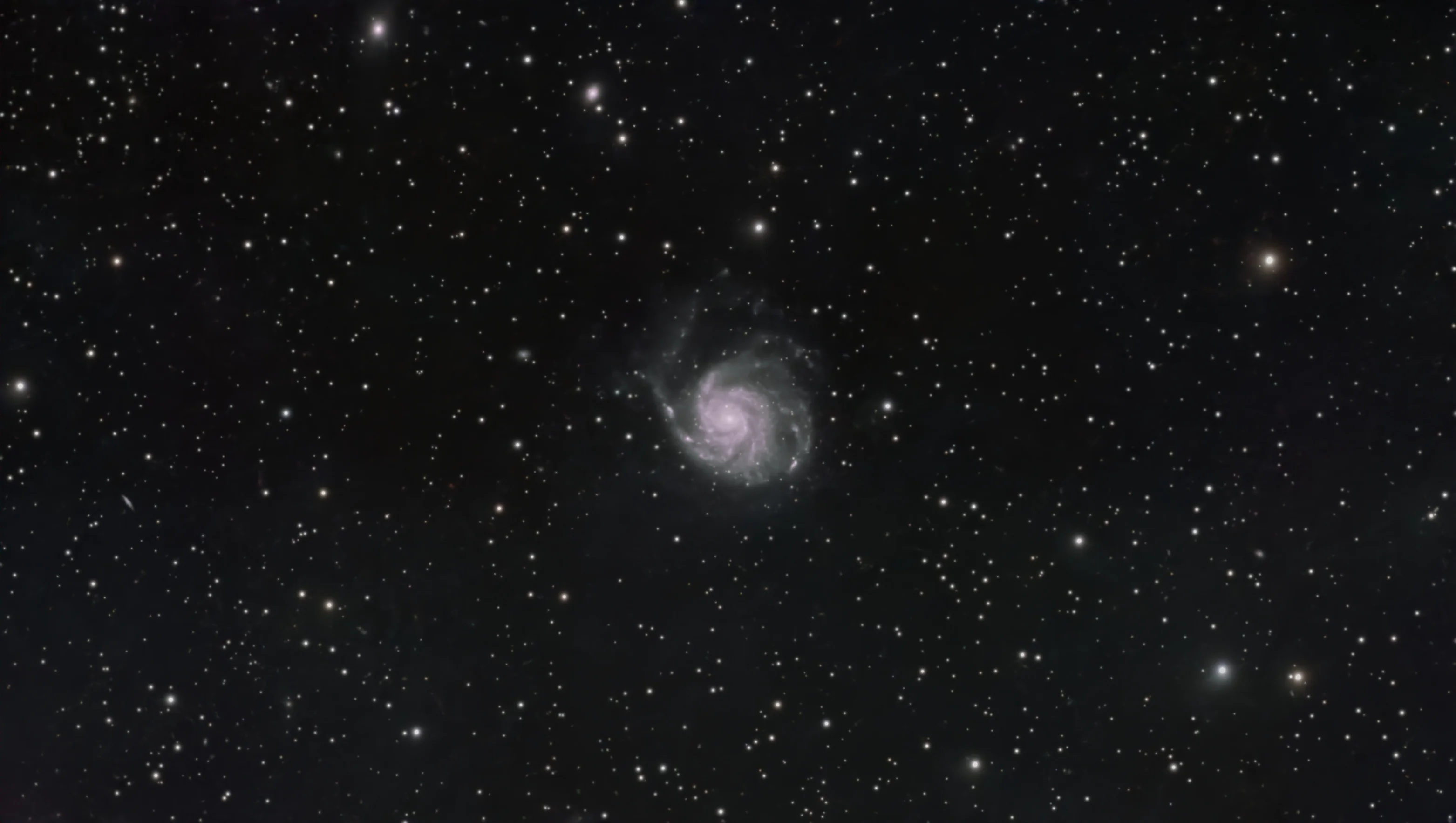
A restack of the Pinwheel, now standing at 9 hours 34 minutes against the 7 hours the previous version carried. M101 is the sort of target where that extra couple of hours is not vanity: it is a face-on spiral, which means all its light is spread thinly across a large disc rather than concentrated into something obliging and bright. The core comes easily. Everything past it is a fight.
What the deeper stack mostly buys is the outer disc. The arms of M101 do not stop where the bright spiral pattern does — they continue outwards as a faint, ragged extension, most obviously sweeping up and to the left of the core in this frame, and that region is where a shallow stack simply gives up and calls it background. It is also the part that carries the galaxy’s real story. M101 is conspicuously lopsided: the disc is offset from the nucleus, the arms on one side are drawn out further than the other, and the whole structure has the look of something that has been leaned on. The usual explanation is gravitational interaction with its own entourage of companion galaxies, NGC 5474 being the prime suspect — itself so distorted that its own core sits well off the centre of its disc.
Scale is the thing that never quite lands in a photograph. M101 spans something like 170,000 light-years, close to twice the diameter of the Milky Way, and it sits about 20.9 million light-years away in Ursa Major. Some of its star-forming regions are so large and so bright that nineteenth-century observers catalogued them as separate objects in their own right — NGC 5461, NGC 5462 and NGC 5471 are all just knots in M101’s arms, given their own NGC numbers by people who could see them but could not resolve what they were part of. They show here as the brighter pink-white condensations strung along the spiral pattern.
That ferocious star formation has a consequence: M101 makes supernovae, and it has been unusually generous about it recently. In August 2011 it produced SN 2011fe, a type Ia caught within hours of explosion and consequently one of the best-observed thermonuclear supernovae in the history of the subject — a benchmark object for the standard candles the whole extragalactic distance scale leans on. Then in May 2023 came SN 2023ixf, a type II core-collapse event and one of the nearest of its kind in decades, close enough that astronomers could go back through archival Hubble and Spitzer images and identify the red supergiant that had blown up before anyone knew it was going to. Two textbook supernovae of completely different mechanisms, in one galaxy, twelve years apart. Neither is visible now, but both happened somewhere in the arms in this frame.
Worth a mention: the field around the galaxy is not empty. Scattered through the frame, particularly out towards the left and lower edges, are small fuzzy smudges that are not stars — background galaxies, far beyond M101 and unrelated to it, sitting hundreds of millions to billions of light-years further out. They are the sort of thing that only starts appearing once the noise floor drops far enough, which is as good a summary as any of what the extra integration was for. Full details, and a link through to the 3D distance view, are on the photo page.