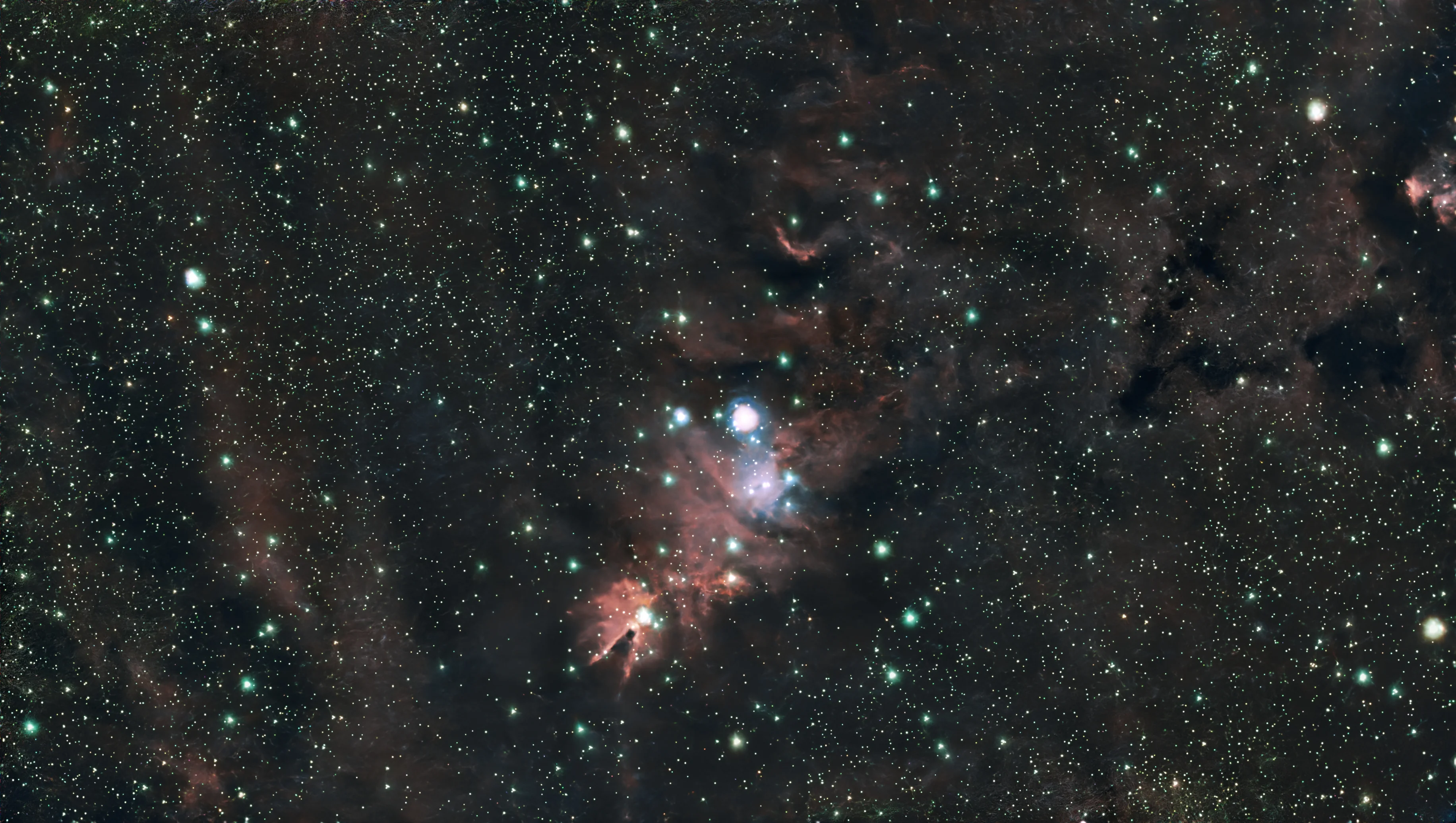
This one has been sitting on a drive for a while. The Cone Nebula, NGC 2264, built from three Dwarf 3 sessions that turned out to be fifteen months apart — one from Christmas morning 2024, the other two from consecutive nights in March this year. Six hours and thirty-eight minutes of integration in total, reprocessed from scratch rather than restacked from the old result.
NGC 2264 is really two objects sharing a catalogue number. The Christmas Tree Cluster is the loose group of young stars at the centre of the frame, and the Cone Nebula is the dark wedge below it, intruding into the glowing gas from the lower left. Both belong to the Mon OB1 association in Monoceros, around 2,600 light-years away, which makes this one of the closest places where genuinely massive stars are still being made.
The cone is the part worth looking at properly, because its shape is a record of something happening rather than an accident of geometry. It is a column of cold molecular dust roughly seven light-years long, and it exists because the material at its tip is dense enough to resist the ultraviolet output of S Monocerotis — the brilliant star sitting above it. Radiation is eating the surrounding cloud away from every direction except the one the pillar shields, so what survives is a tapering shadow that always points away from the star destroying it. Give it another few million years and there will be nothing left to point.
That same radiation is doing the opposite job inside. Compression along the ionisation front is triggering collapse in the gas it hasn’t yet dispersed, and infrared surveys of the region turn up protostars and Herbig-Haro jets scattered right through it. The blue haze around the cluster stars is the Fox Fur Nebula, which is dust scattering starlight rather than gas glowing on its own account — the same distinction that makes reflection nebulae so much harder from a city, since there is no narrow emission line to filter for.
Which is the honest reason this took three nights spread across two winters. Monoceros never gets high from Edinburgh, the target is faint, and the dual-band filter that makes hydrogen-rich targets workable here does nothing for the reflection component or the cluster stars. Stacking sessions separated by more than a year is not something I planned; it is what the target cost. The Bortle page has the arithmetic behind why, and full capture details are on the photo page.