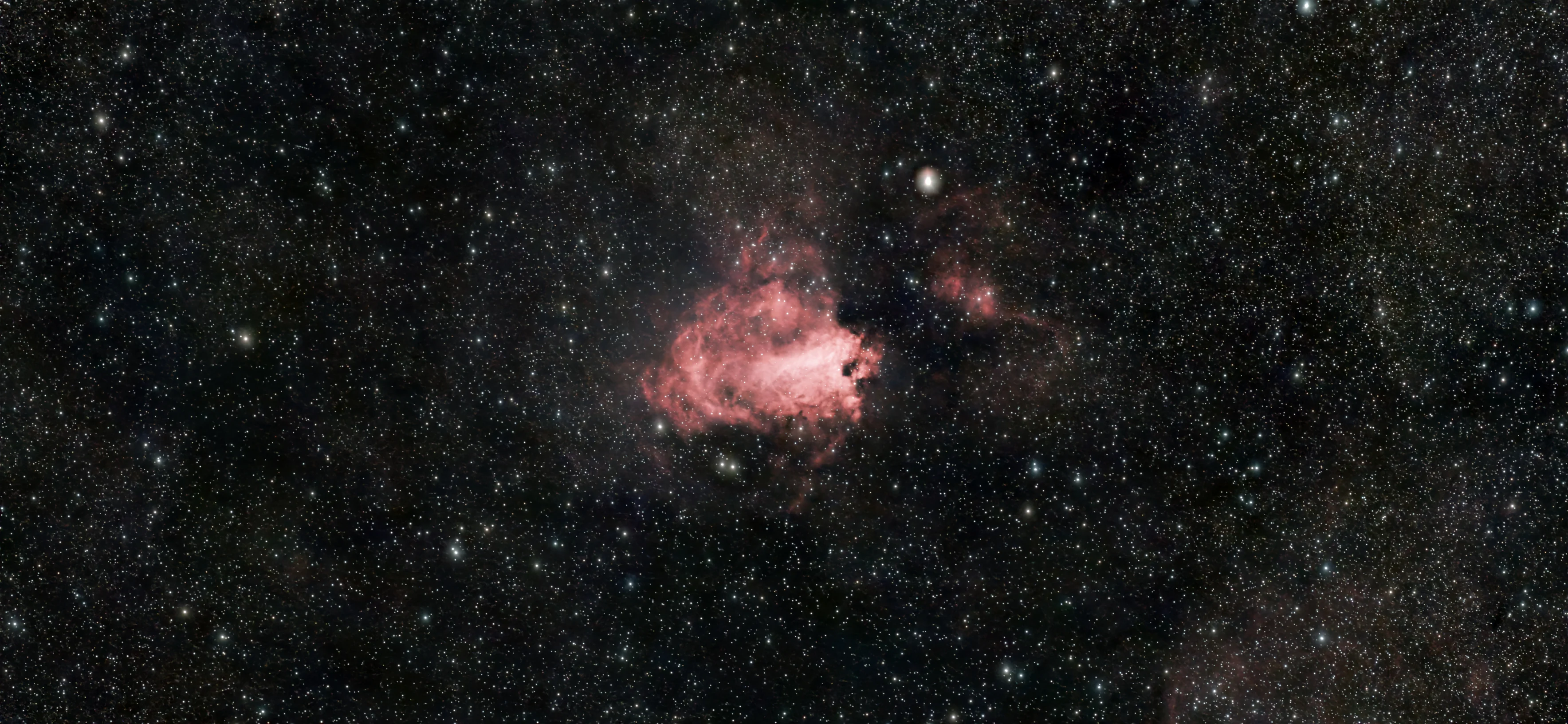
M17 has been on the list for a while, mostly because it is a genuinely awkward target from here. The Omega Nebula sits deep enough south in Sagittarius that from Edinburgh’s latitude it never climbs past about 18 degrees above the horizon — low enough that it is up for only a short window each night, seen through several times the atmosphere of something overhead, and never far from the murk sitting over the rooftops to the south. Three hours forty-five minutes on the night of 20 June this year was what the gap between dusk and the nebula setting again actually allowed.
The catalogue entry undersells it. M17 goes by NGC 6618 and Sharpless 45 officially, and by the Swan, the Checkmark, the Horseshoe and the Lobster unofficially — more common names than almost anything else in the sky, all describing the same hook of glowing gas that dominates the frame here. At around 5,500 light-years, it sits in the Sagittarius star clouds, close to the line of sight toward the centre of the galaxy, which is also why the field around it is this thick with stars. Point a camera anywhere near the Galactic core and the background stops being background.
What lights the hook is NGC 6618, a cluster of roughly 35 hot O and B-type stars that can’t be much more than a million years old. Most of them are invisible here, buried behind the same dust the cluster is still forming out of — a contrast with somewhere like the Orion Nebula, where the ionising Trapezium stars sit right out in the open at the centre of the glow. M17’s cluster works from behind a curtain, so what reaches the sensor is the wall of gas it’s lighting up rather than the stars doing the lighting. The nebula itself is a genuine star-formation engine, one of the youngest and most massive in the Milky Way, with enough surrounding molecular gas to build many thousands of stars like the Sun.
None of that changes the fact that this was shot through the worst part of Edinburgh’s sky, low and briefly, and it shows in how little of the surrounding nebulosity survived compared to what deeper images of M17 pull out. It’s a start rather than a finished account of the target — full capture details are on the photo page.