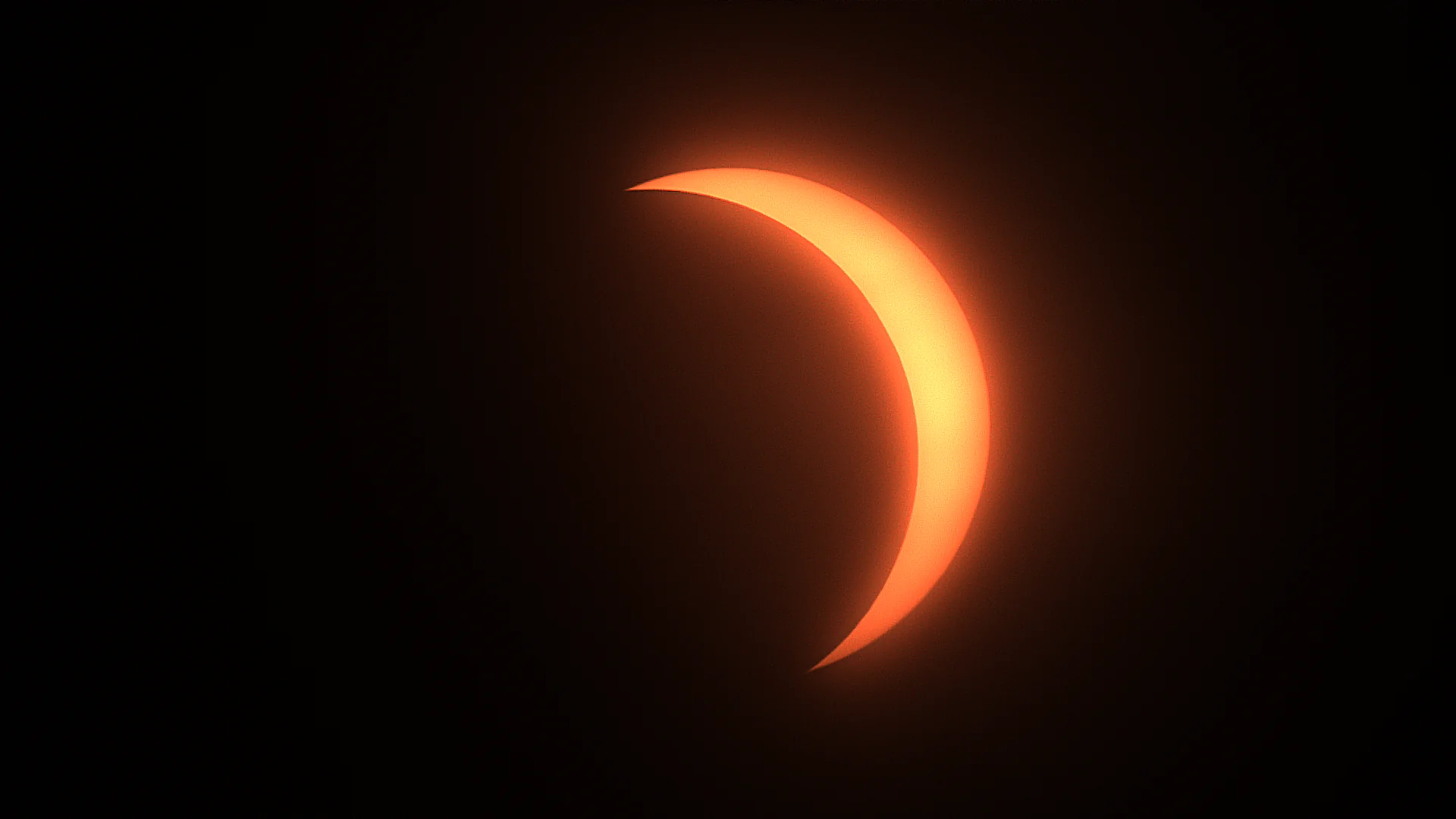
Twenty seconds. That is the whole capture — the shortest thing on this site by a long way, and the only one where the difficulty had nothing to do with collecting photons and everything to do with the sky being clear at one specific moment on one specific evening. Scotland spent most of tonight under cloud. A gap opened for a few minutes, the Sun came through it, and that was the entire observing window.
The 12 August 2026 eclipse was total, just not from here. The Moon’s umbra came down over the Arctic, crossed eastern Greenland and western Iceland, ran out across the Atlantic and finally reached northern Spain with the Sun almost on the horizon — the first totality on mainland Spain since 1905, and the first over Iceland since 1954. Edinburgh sat several hundred miles north of the track and got the consolation prize: about 96% of the solar disc covered at maximum, with the Sun low in the northwest and its light pushed well toward orange by the amount of atmosphere it was coming through at that altitude. What is left in the frame is that last 4%, a thin crescent of photosphere with the Moon’s limb cutting a clean circular bite out of the inside edge.
Ninety-six percent sounds like almost-totality, and it is nothing of the sort. The Sun is roughly 400,000 times brighter than the full Moon, so even a twenty-fifth of its disc is still putting out something like sixteen thousand full Moons’ worth of light. What you get is not darkness but a wrongness — the light goes flat and slightly metallic, colours desaturate, shadows sharpen because the light source has become a sliver rather than a disc, and the temperature drops enough to notice. Anyone who has stood in totality will tell you the difference between 96% and 100% is not four percent of anything; it is the difference between an odd afternoon and the sky going out. Under a solid deck of Scottish cloud you get less of even that — the light was strange, but it is hard to separate an eclipse dimming the sky from the weather already doing it.
Britain has a poor hand for these. The last total eclipse over these islands was 11 August 1999, twenty-seven years and a day before this one, and the last event from Edinburgh of a comparable depth to this was the partial of 20 March 2015. The next total solar eclipse visible from mainland Britain is 23 September 2090, which for most people reading this is a scheduling problem rather than a plan. Spain, meanwhile, is having an extraordinary run: total again on 2 August 2027, then annular on 26 January 2028. Three in eighteen months, after a hundred and twenty-one years of nothing.
Technically this is the least demanding image in the gallery and the one I am most pleased to have. Nothing about it required stacking hours of sub-exposures against light pollution, which is the usual arithmetic of shooting anything from a Bortle 8 city — the Bortle page covers why that arithmetic is normally so unforgiving. It required a filter, a few minutes of cooperative cloud, and being pointed at the right thing while they lasted. The next chance to do better is sixty-four years out, so twenty seconds through a gap will do. Full capture details are on the photo page.