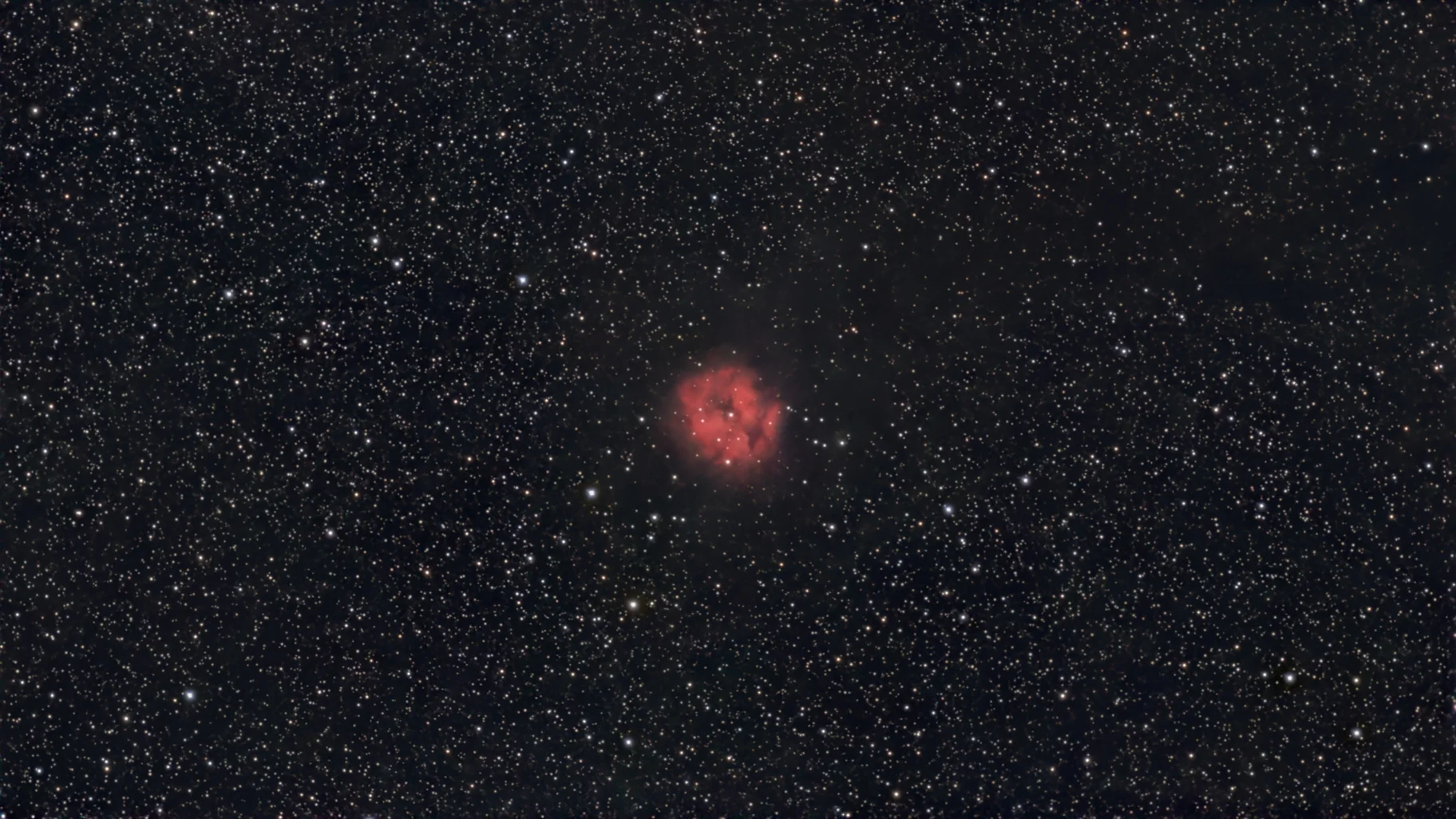
This is the first image on this site that the Dwarf 3 didn’t take. The Dwarf Mini arrived recently, and last night was the first clear one since — an hour and a half on IC 5146, the Cocoon Nebula, from the same Edinburgh back garden as everything else here. Late August is the right moment for it: astronomical darkness has only just come back to this latitude after the summer, and Cygnus is close to overhead by midnight, which means the target is being shot through the least atmosphere and the least streetlight of anywhere in the sky. Ninety minutes is short by the standards of most things in the gallery, and it shows, but the Mini had to start somewhere and this was a fair test of it.
The Cocoon is an unusual object because it is three different kinds of nebula in the same frame. The red is hydrogen fluorescing under ultraviolet light; the paler fringes are dust scattering starlight back at us; and the dark mottling across the face of it is dust doing nothing at all except getting in the way. All three are powered or shaped by one star, BD+46°3474, the bright point sitting almost exactly at the nebula’s centre. It is a young B-type star that condensed out of this cloud and then turned on its own birthplace — ionising the gas around it and excavating the cavity it now sits in. The cocoon is less a shell wrapped around a star than a hole the star has burned into the end of a much larger cloud.
That larger cloud is the more interesting half of the story, and most of it is invisible. Trailing west from the nebula is Barnard 168, a dark lane running several degrees across the sky that is the same filament of cold dust and molecular gas, simply with nothing lighting it. You can see where it runs in the picture by where the stars stop: the field thins abruptly to the upper left of the nebula, and that thinning is absorption, not empty space. Herschel’s far-infrared mapping of this filament turned it into one of the standard textbook cases for how star formation actually proceeds — not in isolated blobs collapsing on their own, but along threads, with dense cores strung out down the length of them. The cluster embedded in the Cocoon, Collinder 470, is roughly a million years old, which is nothing; the filament is still working.
The distance is worth a caveat. The figure quoted almost everywhere is around 3,300 light-years, and that is what the photo page lists for consistency with the rest of the catalogue, but Gaia parallaxes of the cluster members have pulled recent estimates nearer 2,600. As for the Mini: the tighter sensor crops the field to roughly half what the Dwarf 3 sees, which suits an object this compact, but 30 mm of aperture and a quarter of the pixels are exactly the trade the gear page describes, and ninety minutes was not enough to pull the outer wisps or the full extent of B168 out of the background. That is a data problem rather than a telescope problem, and Mega Stack means it is fixable — this one will get revisited.