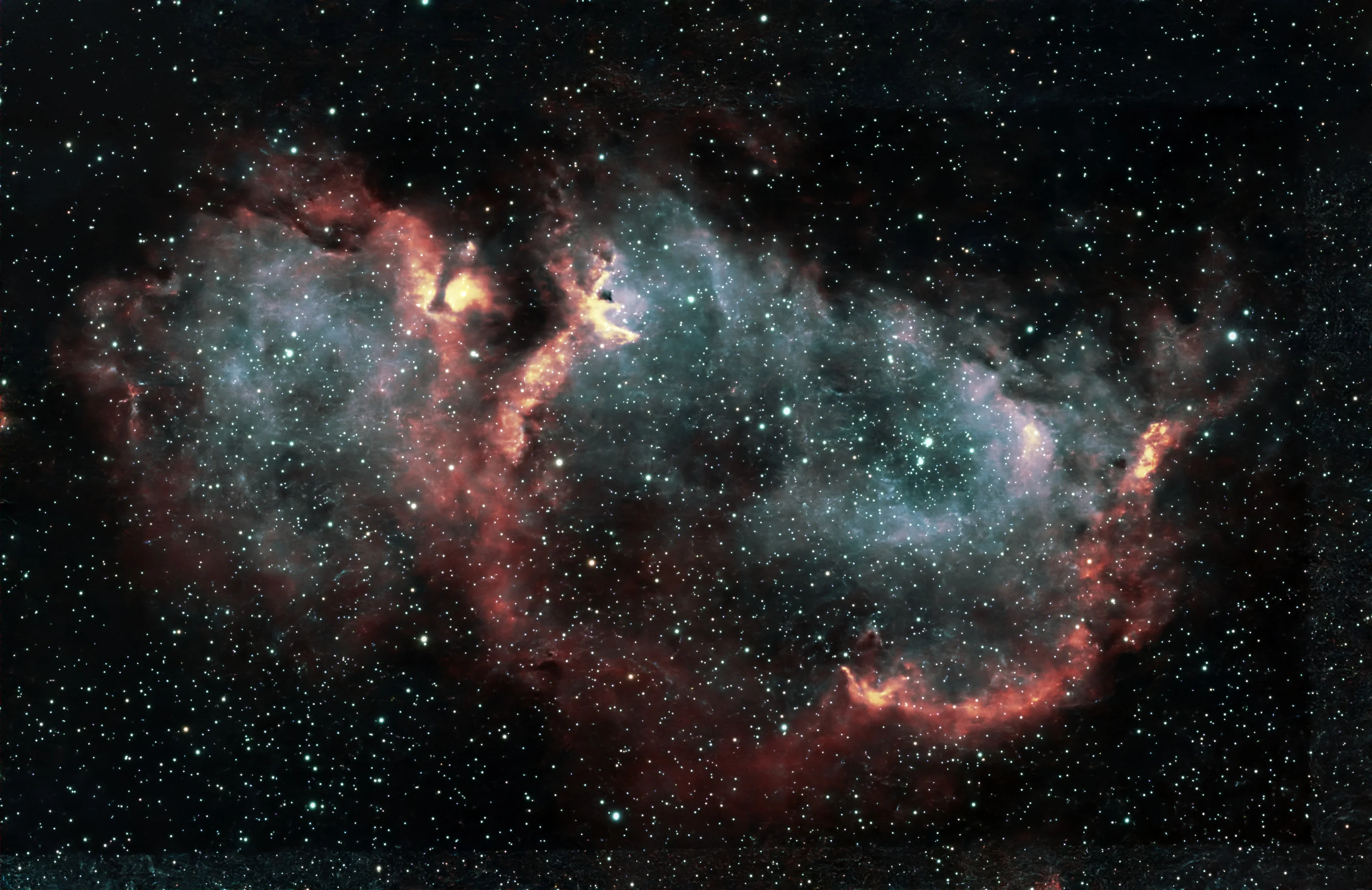
The Soul Nebula has been in the gallery since January, but never on its own — it was the right-hand half of a wide Heart and Soul frame, shot in one sitting with no integration time listed against it, which is this site’s way of admitting there wasn’t much behind it. This is IC 1848 with a frame to itself and 2 hours 27 minutes of integration, captured last night and stacked from both telescopes: the Dwarf 3 and the Dwarf Mini on the same target, folded into a single result.
Early September is when Cassiopeia starts paying its way again from here. Astronomical darkness came back to 56° north a few weeks ago and the nights are lengthening quickly, and IC 1848 sits at declination +60 — circumpolar from Edinburgh, already 55° up in the northeast by midnight and passing within a few degrees of the zenith before dawn. From a Bortle 7–8 back garden that geometry is worth more than almost anything else you can control, because it decides how much atmosphere and how much streetlight the target is being shot through.
What the frame is showing is a cavity system rather than a cloud. IC 1848 is the emission nebula Sh2-199, catalogued by radio astronomers as W5, part of the same star-forming complex as the Heart Nebula around 7,500 light-years away. Two adjacent hollows dominate it, each excavated and lit by a small number of very hot O-type stars — HD 17505 and HD 17520 in one, HD 18326 in the other — whose ultraviolet output has ionised the gas around them and pushed it outward. The bright rims are the ionisation fronts, seen where that expansion is running into denser material, and the ridges and pillars standing along them are the parts dense enough to hold out, each shading a tail of gas behind it. Spitzer’s infrared survey of W5 is the reason this object turns up in textbooks: the youngest stars are concentrated along the rims while the older ones sit inside the cleared-out interiors, which is about as clean a case as anyone has for one generation of stars triggering the next rather than star formation simply happening wherever gas gets dense enough.
Combining the two scopes is becoming routine rather than an experiment. They run the same 150 mm focal length, so the frames land on the sky at nearly the same scale, and the Mini’s smaller sensor decides how much of the field survives into the combination — here that still leaves the nebula filling the frame nearly edge to edge, because IC 1848 is a big object. The Mini reaches less deep per hour, as the gear page says plainly, but hours add up regardless of which instrument collected them, and two and a half of them across two scopes is enough to separate the rims from the interiors and get the pillars to read as structure rather than noise. It’s short by the standards of the deeper entries here, and the Soul will take considerably more, but it’s a start on an object that had none. Full capture details and the 3D distance view are on the photo page.