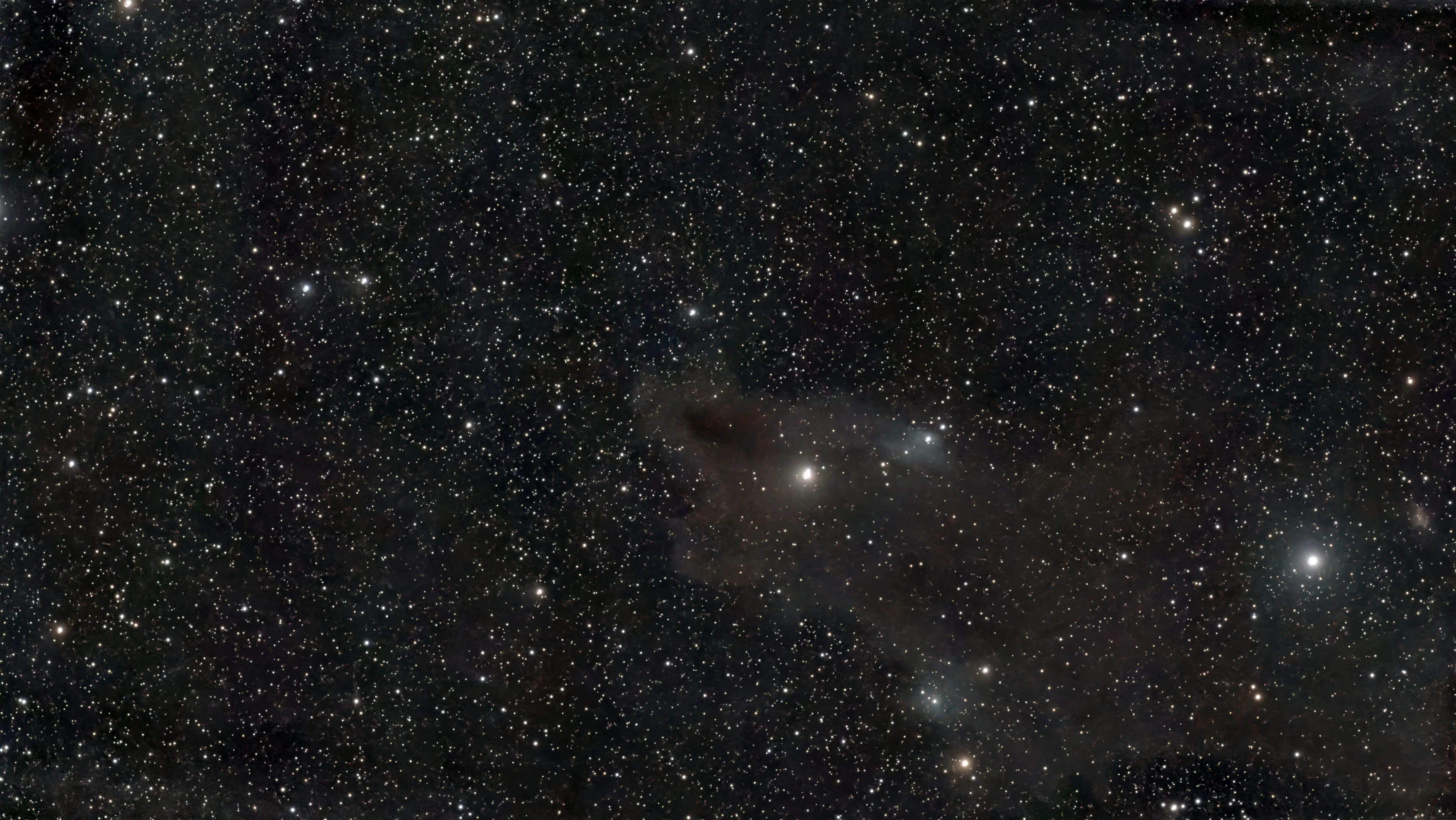
This is one of the longest integrations on the site: 9 hours and 24 minutes on LDN 1235 in Cepheus, captured over two nights on the Dwarf 3, finishing last night. It’s also among the faintest things in the gallery. A dark nebula gives off no light at all. It’s a cloud of cold dust and gas, and the only reason it shows up is that it blocks what’s behind it, so there’s very little signal to collect and the hours are what bring it out of the noise. A few minutes of exposure shows you a field of stars. Nine hours shows you the field of stars with a shark-shaped gap in it.
The shape is easy enough to find once you’ve been told. The darkest patch at the upper left of the frame is the eye, and the body of the cloud trails away to the right, grey-brown and mottled rather than black, because the dust is faintly lit by the combined light of the surrounding stars. Beverly Lynds catalogued the dark core in 1962, which is where the LDN in the name comes from. It’s the densest part of a much larger and fainter complex known as LBN 535, itself part of the Cepheus Flare, a big region of star formation spread across the sky to the north of Cygnus. Young stars are still forming in the thickest parts of the cloud, and the whole thing is only a few million years old.
The best part of the frame, to my eye, is the pair of blue smudges sitting in the dust. These are reflection nebulae, where the cloud scatters the light of a nearby star the way fog scatters a car’s headlights, and blue light scatters most easily. The one just above and to the right of the centre is vdB 149, lit by the star BD+72 1018; the other, lower in the frame, is vdB 150, lit by HD 210806. Both are young B8-type stars, hot enough to light up their surroundings but not hot enough to ionise the gas, which is why the colour here is the cool blue of scattered starlight, not the red of hydrogen emission you get around something like the Soul or Wizard nebulae.
The distance is the one thing nobody agrees on. The figure I’ve used, and the one most often quoted, is around 650 light-years, but other studies put the cloud nearer 1,000 to 1,200. Either way it’s a close neighbour, which is part of why the dust has so much detail in it. The 3D view on the photo page uses 650.
It’s also an unusually good target from Edinburgh. At a declination of +73°, LDN 1235 is circumpolar from 56° north: it never sets, and over the course of the night it swings between about 39° and 73° above the horizon, so even at its lowest it’s well clear of the worst of the haze and the city glow. That is what makes nine hours across two nights realistic. Full capture details are on the photo page.