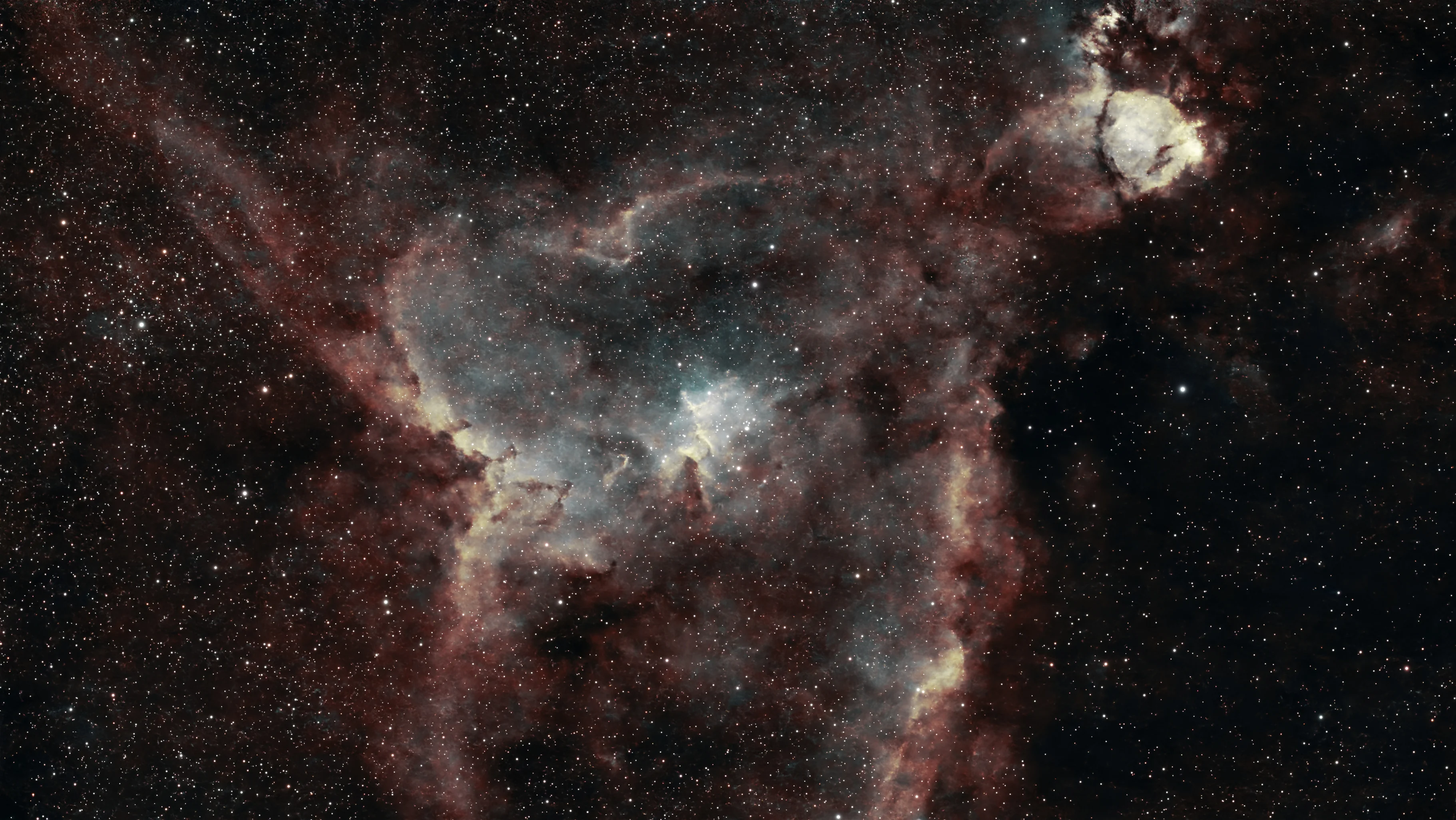
The first version of this one, from February, was a faint red ring with a scatter of stars in it. It had no integration time listed against it, which on this site is usually a sign that there wasn’t much behind it, and you had to know where to look to see a heart at all. This is the same nebula with 2 hours and 52 minutes of Dwarf 3 data, captured last night, and the difference is that the structure is now in the frame instead of being implied by it.
The shape is easier to read than the name suggests. The heart is a cavity. At its centre sits Melotte 15, a young cluster only a few million years old, and it contains several O-type stars, among them HD 15558, one of the most massive stars known in the galaxy. Stars like that are so hot and so luminous that their ultraviolet light ionises the gas around them and their winds push it outward, so over the cluster’s short life they have hollowed out the middle of the cloud. That’s the pale blue-grey space in the frame, and the cluster is the knot of bright stars in the middle of it. What’s left outside is the gas that was too dense to be shifted: the rust-red walls, the golden rims where the radiation is still eating into them, and the dark pillars and dust lanes around the centre and at the lower left.
The extra hours matter most in the outer parts. The Heart is about two and a half degrees across, five full Moons, and the long sweep of faint gas running up to the top left is the sort of thing that vanishes in a short stack. It’s also what lets NGC 896 at the upper right hold together, a bright knot on the edge of the same complex with its own dark lanes cut through it, instead of being a blown-out smudge. William Herschel found the nebula in 1787, though with his telescope it would have been a dim patch, not a heart.
Cassiopeia is a good place to be at this time of year. At a declination of +61°, the Heart is circumpolar from Edinburgh and climbs to within about five degrees of the zenith, so for most of the night it’s looking through very little atmosphere, and well above the city’s worst glow. It’s a short hop across the sky from the Soul Nebula, which sits beside it in the same star-forming complex and which I posted in September. Full capture details and the 3D distance view for this one are on the photo page.