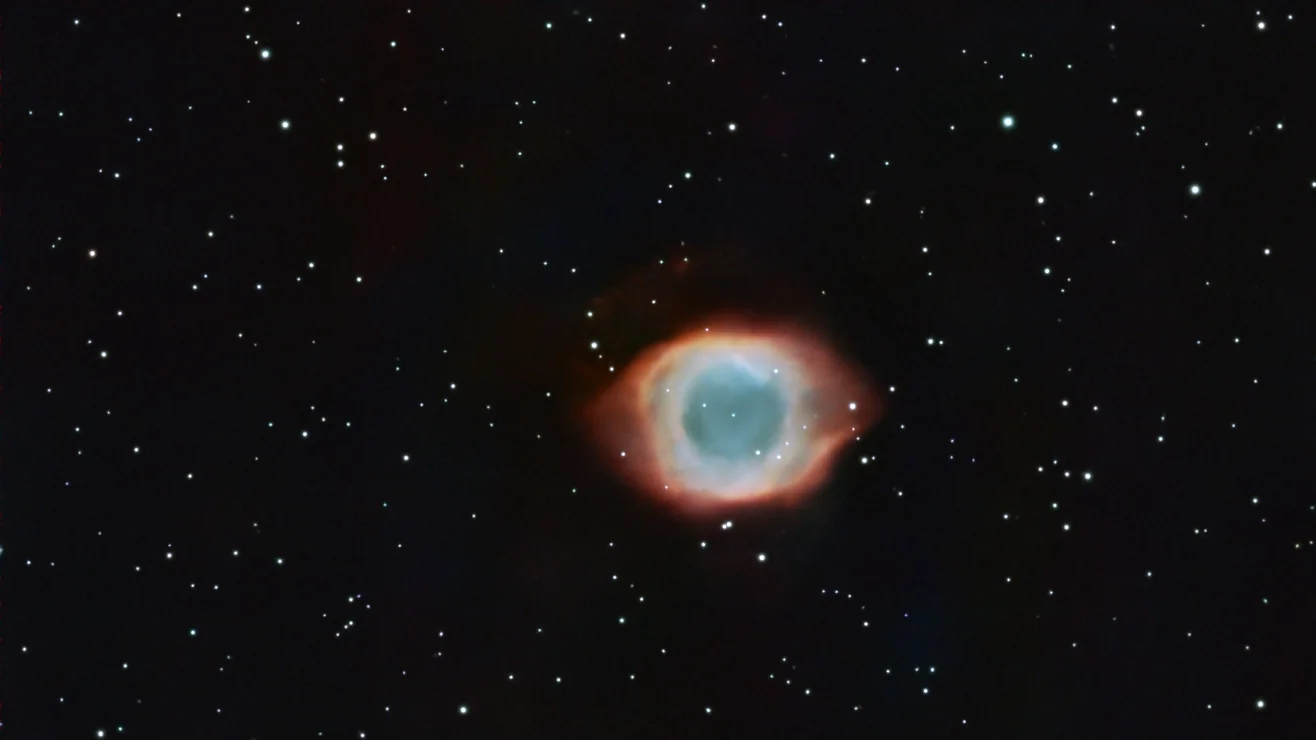
This is the first capture on the site from outside Edinburgh. I took it on Kos, between the 16th and the 19th of October, and it adds up to 2 hours and 34 minutes on the Dwarf 3. The Helix was the obvious thing to point at on a trip south, because from home it’s close to hopeless.
The reason is declination. The Helix sits at about −21°, which from Edinburgh means it never gets much higher than 13° above the southern horizon, right in the thickest part of the atmosphere and the worst of the city glow. From Kos, at about 37° north, it climbs to over 30°. That’s still low, but it’s the difference between a smear and a nebula, and it’s why the colour here has come through so cleanly. A target I could never realistically do from the garden turned out to be something I could do from a holiday.
It’s not a planet, despite the name. Planetary nebulae were called that because the early telescopes made them look like the discs of planets, and the label stuck. What you’re looking at is the outer atmosphere of a star like the Sun, shed over roughly ten thousand years once it ran out of fuel in its core. The star itself is now a white dwarf, a hot, dense remnant at the centre of the ring, and its ultraviolet light is what makes the gas glow. The blue-green middle of the frame is doubly ionised oxygen; the red ring around it is hydrogen and nitrogen in the cooler, thinner outer shell. In a longer exposure the fainter, dustier halo of red around the outside starts to show up too.
At about 650 light-years the Helix is among the closest planetary nebulae to us, which is why it’s so large on the sky: roughly half the width of the full Moon, and around 2.5 light-years across in reality. Even so, on a small smart telescope it fills only a modest part of the frame, and most of the picture is the star field around it. The ring looks round because we’re seeing it close to end-on; it’s thought to be a tilted cylinder or a pair of rings rather than a sphere. Karl Ludwig Harding found it before 1824, and the popular name, the Eye of God, is hard to argue with once you’ve seen it.
The Sun will do something very similar in around five billion years, so in a sense this is a preview. Full capture details and the 3D distance view for this one are on the photo page.