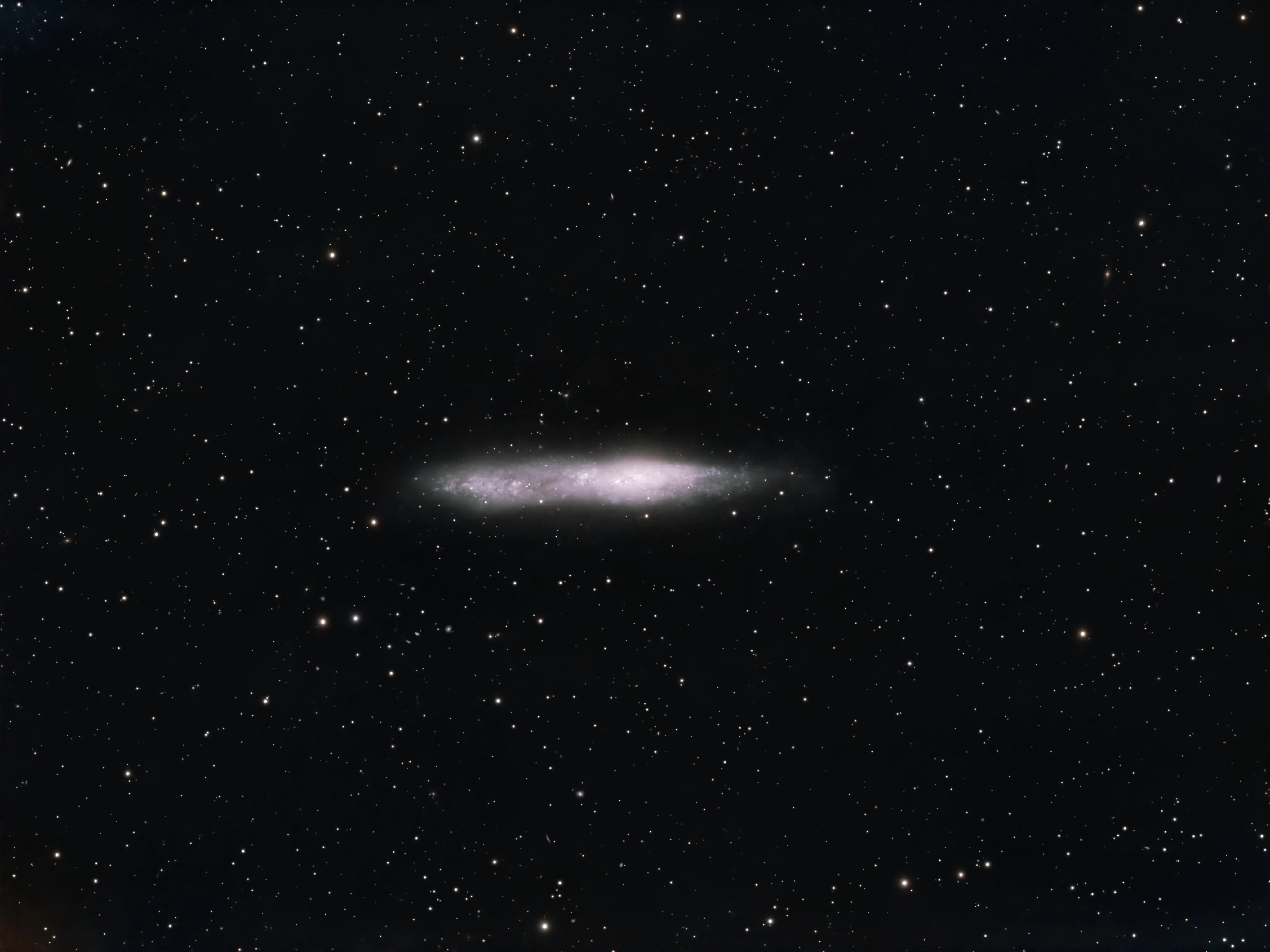
This one is different from everything else on the site, because I didn’t capture it. DWARFLAB gave me access to a set of FITS files from their DRACO, and what you’re looking at is my own processing of their data. I’ve never had the unit in my hands; the files arrived, and the rest was me and Astrowizard.
Data supplied by DWARFLAB. Target: String of Pearls Galaxy (C72 / NGC 55). Captured with DRACO using Astro filter under Bortle 2 Skies, with 300s, 120g and 1 hour 45 minutes integration. I did not physically operate the unit for this evaluation.
It’s also a target I could never shoot from home, however much time I had. NGC 55 sits at a declination of about −39° in Sculptor, and from Edinburgh, at 56° north, that puts it permanently below the horizon. Even from Kos, where the Helix finally became possible, it would never get much above 14° over the southern skyline. It belongs to southern skies, and the Bortle 2 sky behind this data shows: the background is properly dark, and there’s none of the gradient fighting I’m used to with my own Bortle 7–8 frames.
The galaxy itself is a barred spiral around 6.5 million light-years away, which makes it one of the nearest galaxies outside the Local Group. We see it almost exactly edge-on, so its whole disc is squashed into a long, bright blade of light. The name comes from what’s along that blade: clumps of young stars and star-forming regions strung out like beads, which processing brings out as the mottled, knotty texture along its length. The brightest part isn’t in the middle, either. It sits off to one side, because NGC 55 is a lopsided, Magellanic-type spiral, a lot like the Large Magellanic Cloud seen from the side.
It’s part of the Sculptor Group, one of the closest groups of galaxies to our own, and it may be gravitationally tied to its neighbour NGC 300, which lies a little further off in the same patch of sky. James Dunlop found it in 1826 from Parramatta in New South Wales, which feels right for a galaxy that most of the northern hemisphere has to take on trust.
Processing someone else’s data turned out to be a good exercise in its own right: no decisions about framing or exposure to second-guess, just the stack and what could be got out of it. Full details and the 3D distance view for this one are on the photo page.