North American Nebula
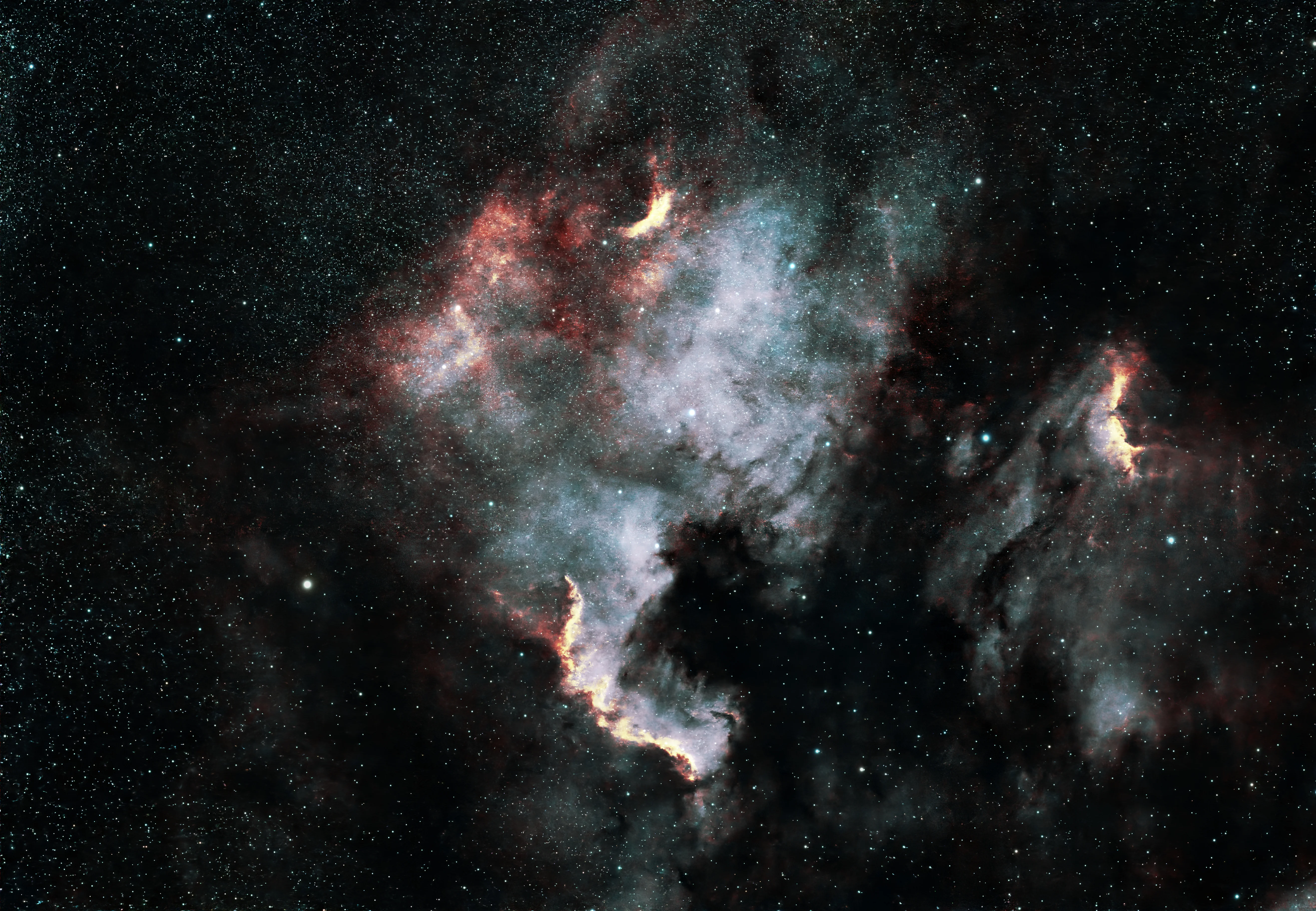
NGC 7000 in Cygnus is a large emission nebula around 2,590 light-years away, and the continent everyone sees in it is drawn not by the glowing gas but by what lies in front of it: the dark cloud LDN 935, whose silhouette carves out the Gulf of Mexico, the eastern seaboard and the Florida peninsula. The same cloud separates it from the Pelican Nebula (IC 5070) to the west, and the two are really one object — a single region of ionised hydrogen roughly 100 light-years across, cut in half by a foreground rift of dust. For decades nobody could say what was lighting it, because the source is hidden behind that dust as well: an O-type binary now known as the Bajamar Star, buried in LDN 935 roughly where the Bahamas would sit, whose ultraviolet output ionises the whole complex from behind the Gulf. The brightest ridge, the Cygnus Wall along the Central America edge, is where that radiation meets the densest gas and is compressing it into new stars; the sharp rims on the Pelican’s head and neck are the same ionisation front seen on the far side of the lane. William Herschel found the nebula in 1786, and Max Wolf’s photographs a century later were what first made the map legible.