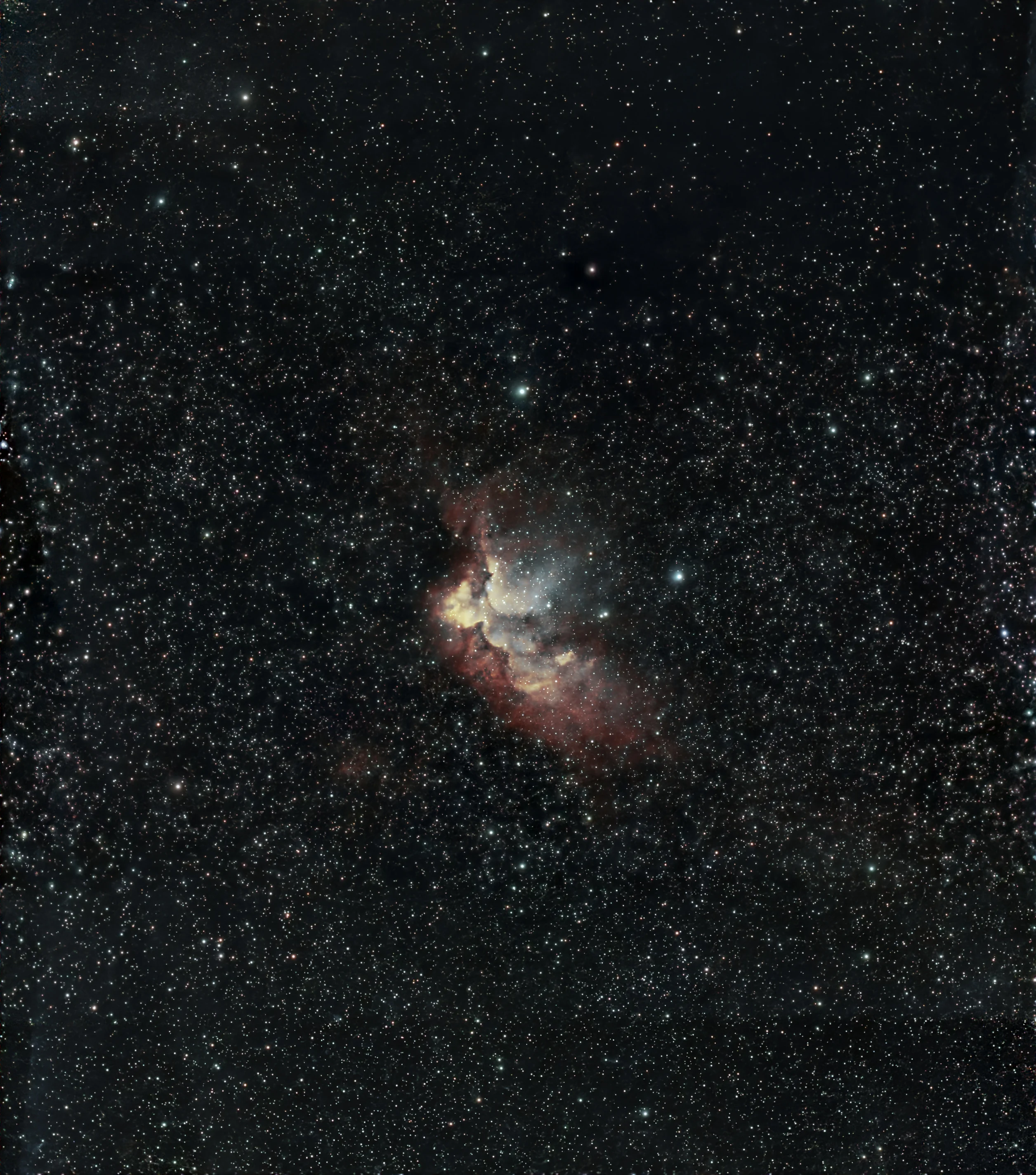
The first version of this one, from April, was among the thinnest entries in the gallery — a wide Dwarf 3 frame with no integration time listed against it at all, which is this site’s way of admitting it was a single short sitting. NGC 7380 came out of it as a pale salmon smudge with a hint of structure and not much else. This is the same object with 6 hours 30 minutes behind it, and with both telescopes contributing: the Dwarf 3 and the Dwarf Mini on the same target, folded into one stack.
Late August is the moment to take another run at Cepheus from here. Astronomical darkness has only just returned to 56° north after the summer, and NGC 7380 sits at declination +58 — circumpolar from Edinburgh, and passing almost directly overhead around the middle of the night. That is as good as the sky gets in a city: the target is being shot through the least atmosphere and the least streetlight available, which for a Bortle 7–8 back garden matters more than almost anything else you can control.
What the extra hours buy is the machinery of the thing. The cluster and the nebula are one object at two stages — a knot of stars roughly 4 million years old, still sitting inside the cloud that made them, about 7,200 light-years away. Nearly all the ionising light comes from a single source, DH Cephei, a close binary of two O-type stars near the centre that orbit each other in a little over two days. Their ultraviolet output is what makes the hydrogen glow red, and it is also what is eating the cloud: the bright pale cavity in the middle of the frame is gas that has already been ionised and blown clear, and the cream-coloured ridges around its lower edge are the ionisation front itself, seen where it is ploughing into denser material. The dark towers and pillars silhouetted against it are the parts holding out — Bok globules and evaporating gaseous globules, dense enough to shade a tail of gas behind them, some of them with new stars condensing inside. The wizard silhouette people see in wide-field versions is a coincidence of viewing angle, but the shapes making it are not decorative; they are the erosion front drawn in gas.
Combining the two scopes works better than I expected it to. They run the same 150 mm focal length, so the frames land on the sky at nearly the same scale, and the Mini’s smaller sensor simply sets how much of the field survives into the combination — which is why this is a tall, tight crop where April’s was a wide landscape. The Mini reaches less deep per hour, as the gear page says plainly, but hours are the one thing that can be added to, a clear spell at a time, and it turns out a second scope on the same target is just another way of adding them. Full capture details and the 3D distance view are on the photo page.