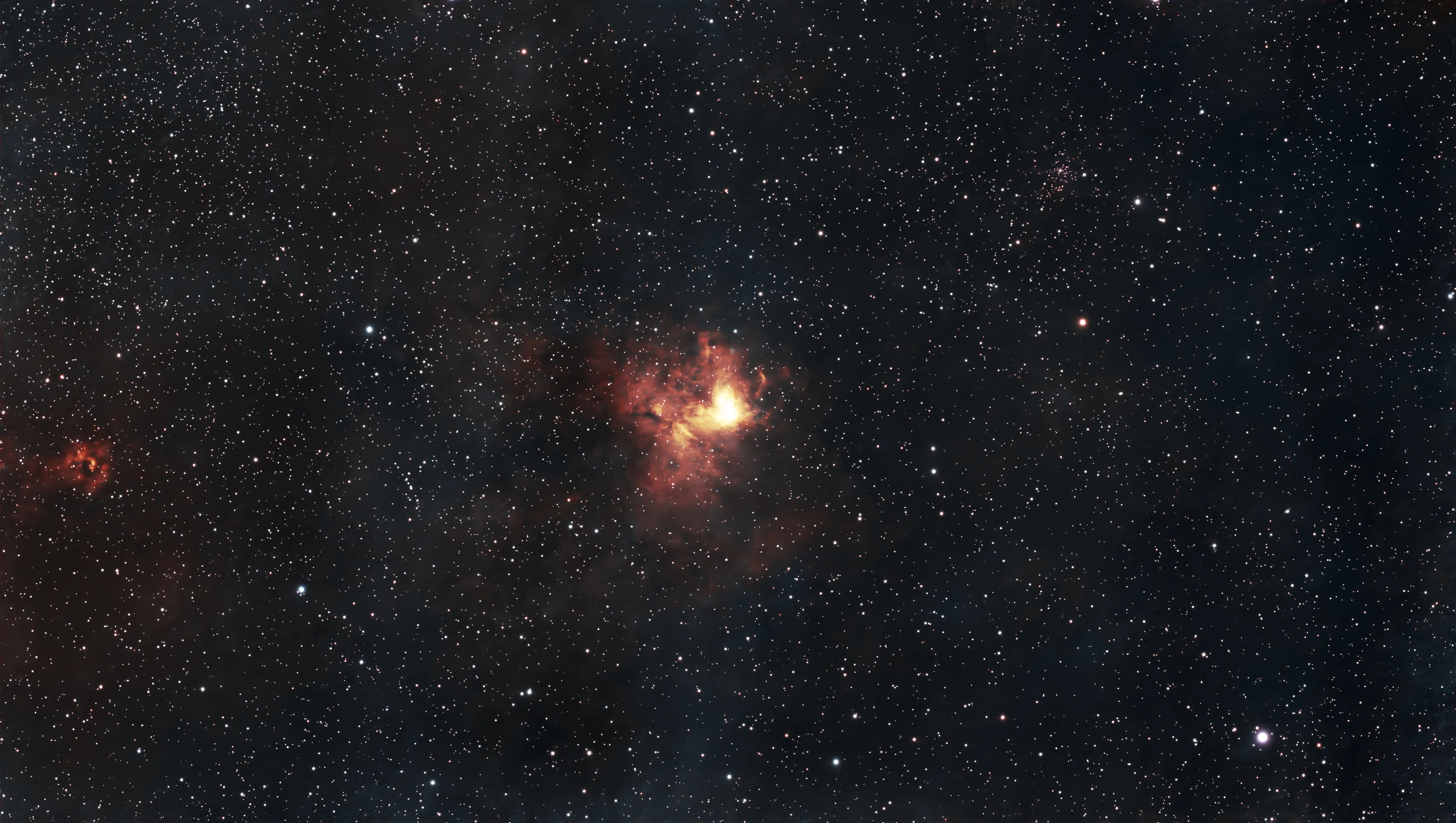
This is 4 hours and 59 minutes on NGC 1491, the Fossil Footprint Nebula in Perseus, captured last night on the Dwarf 3. It’s a nebula I hadn’t tried before, and it’s one that rewards the time: a short stack gets you the bright core and very little else.
It’s a small target for this telescope. The bright part is only a few arcminutes across, and even with the fainter gas around it the nebula takes up a modest patch in the middle of a three-degree field. I’d normally think twice about something this size, but it’s bright for what it is, and the long integration has pulled out enough of the surrounding glow that it sits in the frame as a proper object and not a smudge.
What makes it interesting is how simple the story is. Almost everything you can see is being lit by one star, BD+50 886, an eleventh-magnitude O-type star sitting right beside the brightest part of the nebula. Stars like that are hot enough to ionise the hydrogen around them and windy enough to push it away, so it’s blowing a bubble in the cloud it formed from. The yellow-white core is where the star is working on the densest gas, along the edge of that bubble. The rust-red fan spreading away to the left is thinner material further out, and the dark lines across it are dust in front of the glow. Between them, the bright core and the dust lanes make the lobed, stamped-in shape that gives it the name.
It’s a long way off. The usual figure is around 10,700 light-years, which puts it out in the Perseus Arm, the next spiral arm outward from ours, and makes it one of the most distant nebulae I’ve captured within our own galaxy. William Herschel found it in December 1790.
There are a few other things in the field. The small red patch at the far left edge is Sh2-209, another star-forming region that is further away again and has nothing to do with NGC 1491 beyond lying in the same direction. The faint, tight knot of stars at the upper right is the open cluster King 7, and the bright star at the lower right is 43 Persei, which at roughly 125 light-years is a near neighbour by comparison with everything else in the picture.
Perseus is about as well placed as anything gets from Edinburgh at this time of year. NGC 1491 sits at a declination of +51°, so it’s circumpolar from here and passes within five degrees of the zenith, well clear of the city glow that does the damage lower down. That, and November nights being long enough to fit five hours into one session, is most of the reason this worked. Full capture details and the 3D distance view for this one are on the photo page.