Fossil Footprint Nebula
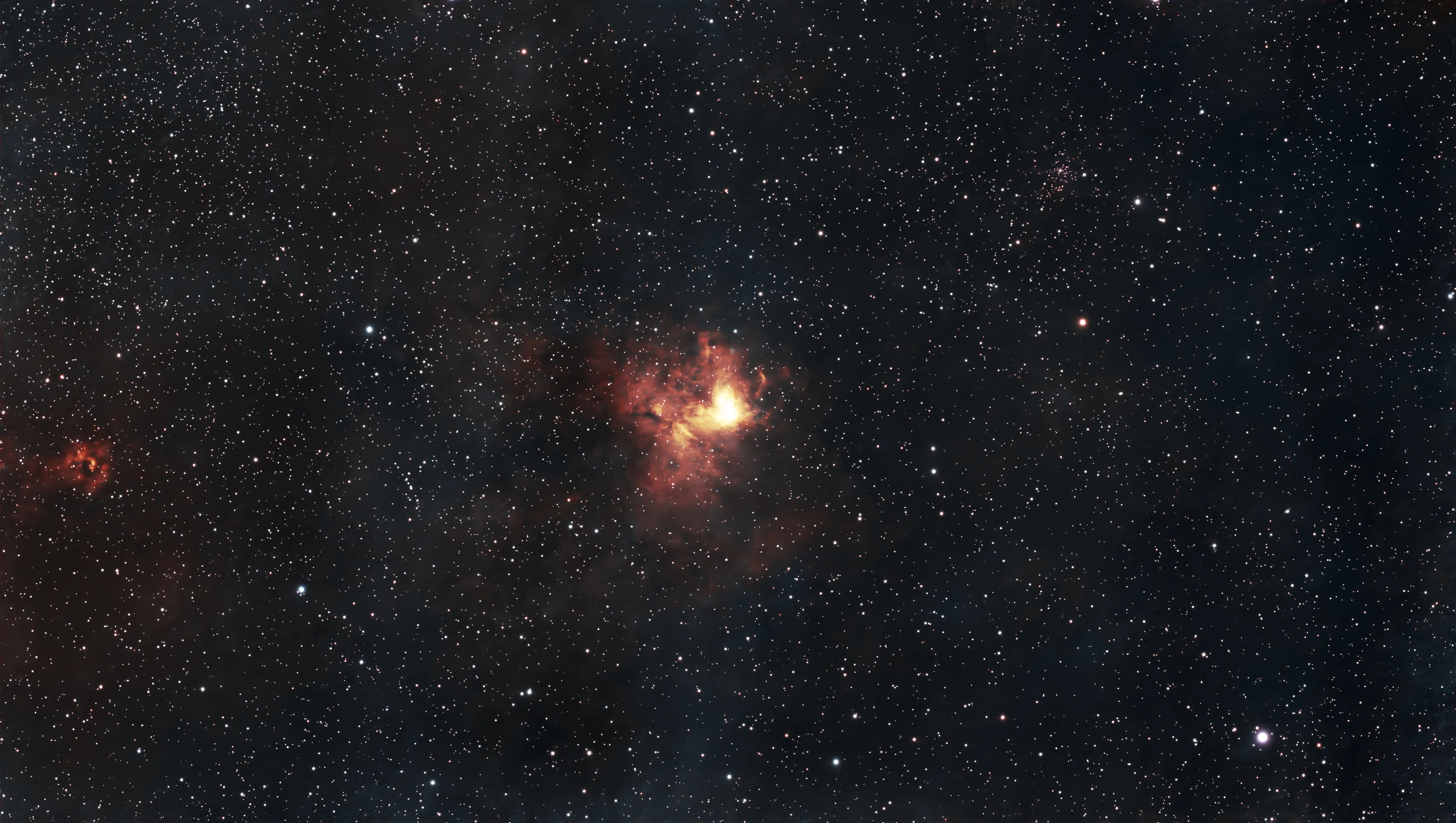
NGC 1491 in Perseus is an emission nebula around 10,700 light-years away, out in the Perseus Arm of the galaxy, and almost all of its light is the work of one star: BD+50 886, an eleventh-magnitude O-type star sitting just beside the brightest part. Its ultraviolet radiation ionises the hydrogen around it and its wind is hollowing out a bubble in the cloud, so the brilliant yellow-white core is the dense gas along the edge of that cavity, where the star is eating into the thickest material, and the dimmer rust-red glow fanning out to the left is the thinner gas beyond. Dark dust lanes cut across the bright region and give it the lobed outline behind its nickname. William Herschel discovered it in December 1790. The small red patch at the far left of the frame is Sh2-209, a separate and more distant star-forming region, and the faint knot of stars at the upper right is the open cluster King 7.